Saying it out loud

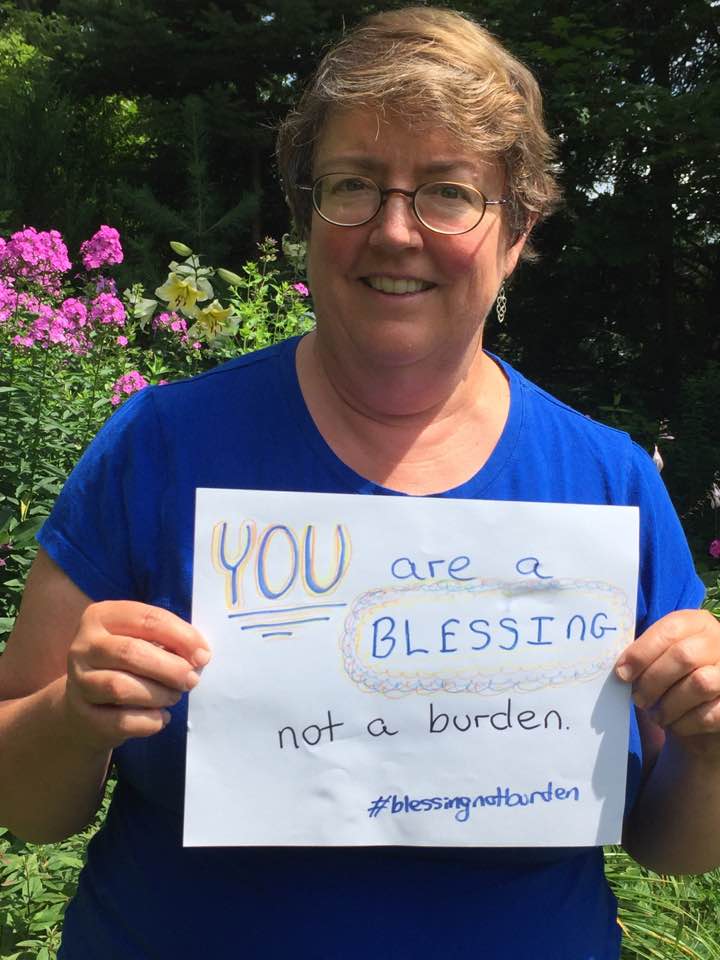
OK, honestly, I feel a little silly standing in my garden holding a sign.  The first time I did it, my sign read, “YOU are a blessing, not a burden.”   I would have been glad to give that message to anyone since that has been the core of my ministry for the last 30 years.  People doubt themselves, they don’t recognize their God-given value, they forget (or never heard) that they are beloved children of God. I feel called to remind them who they are in God’s eyes.

That particular sign was aimed specifically at the LGBT community and especially the Trans community who heard our President say that trans people should no longer serve in the military because they are a burden to the system.

Since the suicide rate among trans people is already higher than any other demographic in our country (about 40% have attempted), I don’t want anyone to be tipped into despair or self-loathing by careless or mean-spirited words.

Instead, I would like trans people – and all people – to know

  • YOU are a blessing.
  • YOU are created in the image of God.
  • YOU are loved and lovable.
  • YOU are of great value.
  • The world needs YOU, your gifts, and your outlook.

So I stood in my garden, held my sign, and posted it on social media. My intent was to share this positive message of love and affirmation as widely as possible.  Maybe those simple words gave someone hope or reminded someone of their importance.

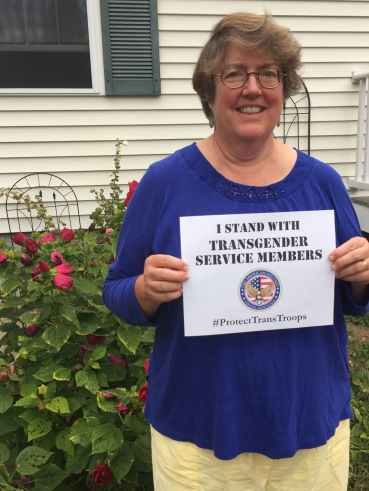
On Sunday I received an email with another sign from a military veteran in my congregation. This one states, “I stand with transgender service members.” Approximately 15,000 transgender active, reserve, and Guard troops may be discharged because of an upcoming ban on transgender people serving in the military. This veteran was requesting that everyone spread a message of support for these courageous members who voluntarily serve in our military.
Blessing 2

I printed out that sign, stood with it in my garden and again posted it publically.  I wish the signs weren’t necessary. I wish it was obvious that all of God’s people are of equal and eternal value.

But we are living in a time with an abundance of negativity and hate.

It’s time for more signs.

People of faith need to act. It isn’t enough to simply believe something. We need to speak our faith and then live it. A few weeks ago, I wrote about words that should never be spoken because of the harm they can do.

But the opposite is also true. Some words absolutely need to be said out loud. Words against racism and exclusion.  Words supporting compassion and welcome. We need speak God’s love out loud, with our words and our actions. And if that means I need to stand in my garden holding a sign that proclaims God’s love and my support for all of God’s people, I will do that – over and over again.

I hope my sign and my words will speak to someone who needs to hear they are not alone. I hope they will remind all of us to treat one another with respect and consideration.

Stones with stories

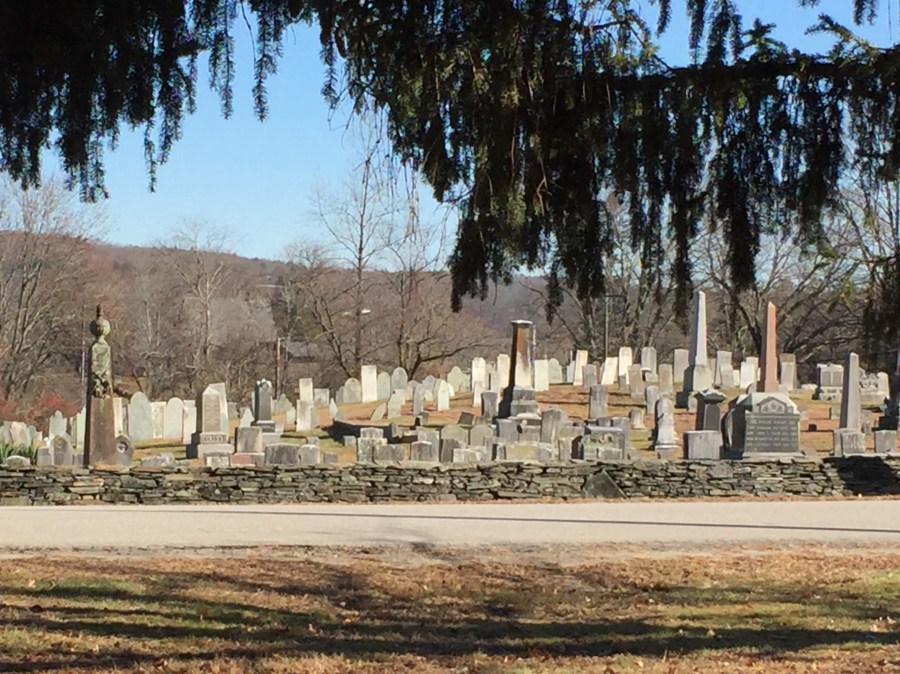
I spend more time in cemeteries than the average person.  Call it an occupational hazard. In all sorts of weather, I have found myself graveside, offering prayers as this bit of earth is consecrated as a final resting place.

People often shudder when I mention my frequent visits to graveyards.  They wonder, “Isn’t it depressing?” as they confess their avoidance of cemeteries. Perhaps it is a ministerial oddity, but I find burying grounds fascinating and often, strangely, comforting. The stones inscribed with names and dates hint at stories of lives gone by. Some are forgotten, others are treasured memories, but all were children of God, beloved and cherished. And now entrusted into God’s eternal care. It is humbling to remember that all lives – those rich, famous, and powerful and those poor, broken, and lonely – will end.  Death is that great equalizer that each of us encounters.

It is said that Protestant reformer Martin Luther kept (1483-1546) kept a human skull on his desk as a reminder of his own mortality and the brevity of human life. Thankfully no skull lingers in my church office but the view from my desk offers a lovely glimpse of our village graveyard. It reminds me of how fleeting life can be and how precious every moment is. It brings to mind the many gatherings I have officiated in cemeteries over the years.

Sometimes those gatherings are filled profound, almost crippling, sadness as we mourn a life cut short by disease or accident. Sometimes we are bombarded with painfully poignant regrets as we say, “I wish it could have been different.” Yearning that circumstances could have been different as we mourn someone overcome by addiction or unable to ask for help or not able to receive forgiveness from self or others.

Sometimes the people huddled by the dirt mound and silent stones experience a sense of relief or rich gratitude that a life well-lived has peacefully come to end, offering a well-deserved rest.

While I am at the cemetery, often before the service begins, I wander between the rows of stones, reading the inscriptions. They hint at lives gone before, some tragically short, others decades long. Most are unknown to me, which makes me wonder about the feelings and experiences, hopes and dreams of those who lie beneath.

So many stones. So many stories.

Rather than being depressing, I find silent stones inspiring. They inspire me to keep things in perspective and to let go of trivial grievances. They inspire to try to make a difference now, today, while I can. And they inspire me to cherish my loved ones and give thanks for the blessings we enjoy.

Those silent stones speak volumes, if I am willing to listen.

Standing up for Peace

Does standing on a street corner change the world? I wondered that as I stood with about 15 other folks at an intersection in a quiet New England town, population 4,124, with a racial diversity score of about zero.

What was I accomplishing? Was anything achieved?

Maybe not. But two days after the white supremacy rally in Charlottesville VA, I felt the need to do something. And standing with signs that read “Peace” and “End Bigotry” and “Love is louder than hate” helped us bear witness to the powerful vision of hope. It was a way to say “no” to that hate-filled rally.

One man in a truck shook his head and gave us a “thumbs down” signal. I wondered exactly what he was disagreeing with. Peace is not a good idea? Diversity shouldn’t be encouraged? But it was not a place for conversation so I’ll never know what his thoughts were.

Mostly we heard horns honking as drivers smiled and waved or flashed the peace sign. One bicyclist shouted, “Good job!” as he sped past. Several people shouted, “Thank you!” as they drove by.

The world didn’t change on that Monday afternoon. But our voices of hope and determination were heard. A witness to peace, unity and love was given.

I stood up for peace because I didn’t want the marchers in Virginia to have the last word. In our media-saturated world where images of angry torch-bearing racists fill our screens, it’s too easy to believe that their voices were the only ones speaking.

But this ragtag group of women and men, one little girl and a couple of dogs stood together for peace. And that action was repeated in towns and cities across our country. Those gatherings – big and little, at rural intersections and city parks – are a reminder that every action of kindness, love and welcome is important.

Peace 6

It’s time to do what we can, in big and little ways. In some ways, it’s easy to stand up against obvious hatred like Nazi flag-wielding thugs. It’s clear they are on the wrong side of history and that their message has no place in a fair and equal democracy. They are dangerous and disturbing, but in a loud, in-your-face kind of way.

Subtle forms of racism are more challenging to recognize and rebuke. I hope our street-side gathering also reminds us to be aware and stay attuned to the many ways that too many people are treated differently.

  • One kind word
  • One small protest
  • One refusal to allow hate to have the last word

These actions, taken together, can change the world.

Never doubt that a small group of thoughtful, committed citizens can change the world; indeed, it’s the only thing that ever has.” – Margaret Mead

Organizing your life and other summer dreams

Have you heard of a “bullet journal”?  The 20-somethings who share our home assure me this is the latest thing to help organize your life and prioritize your activities.  I have kept a journal – just a journal, no “bullets” involved – since I was 13. I write in my daily to review my yesterday, pray for my today, and jot down hopes, dreams and some worries for the future.

But I was intrigued that my app-addicted young adults could be inspired by something as low-tech as a notebook and a pen.  I did some research, on-line of course, and discovered www.bulletjournal.com .  A four-minute video explains how a bullet journal can “track the past, organize the present, and plan for the future.”

Sounds good, right? In many ways, the bullet journal is a glorified “to do” list, with “bullet points” to check off when an action is accomplished. It promises a quieter mind and a calmer spirit as users “focus on things that are really worth your time.”

What is worth our time? It’s something to ponder before these precious summer days slip away. What activities and experiences feed your spirit and nourish your soul? What is really worth doing? Perhaps just as important – what is not worth our time? What dreary, tiresome behaviors can we eliminate from our daily routines so we make room to expand our hearts and listen for God’s Spirit?

“Seek the Lord,” the Bible tells us, “and you will find him” (Deuteronomy). The wise teacher in Proverbs assures us if we “seek diligently” we will discover God. And Jesus encourages us to “seek and you will find.”

That’s worth doing. This summer we can intentionally make time to seek God and be aware of God’s presence.  Where will you encounter God in the coming weeks? Will you listen for God’s voice as waves break against the coast or as water gently ripples upon a lakeshore? Will you look for God in the early-morning light or in the dimming of these longer days? Perhaps the flickering light of fireflies and stars will remind you of light shining in the darkness, of God’s promise to be with us always. The joyful exuberance of festivals or outdoor concerts might move you to sing praises to God. Loving moments with family and friends could reassure you that where there is love, there is God.

Notice. Be aware. Pause. The bullet journal’s popularity comes from its encouragement of intentional living.

Starting today, take five minutes at the beginning or end of each day to review your blessings and notice where you encounter God. An awareness of the divine weaving its way in and through our lives can change our outlook on life. God promises to “be with us always, now until the end of the age.”  Let’s take time to notice.

Got privilege?

The phrase “white privilege” troubles many people. Often an instant response is, “I’m not privileged. I’ve worked hard to get where I am today. Nobody gave me anything.” We equate “privilege” with wealth or entitlement or ease. That, of course, is the trouble with words – they fail to describe what we are attempting to define.

In this case, “privilege” is the ability to participate in an activity without hindrance.

Think of it this way.  What if we substitute the word “white” with another word.

Consider this –

  • My mother is blind. Ordinary daily activities are challenging, from choosing clothes to wear, to safely navigating crowded hallways, or pouring a cup of hot coffee.
  • I, on the other hand, can do things that sighted people do – use my phone, drive a car, find an item that I’ve put down, read the newspaper, or cross the street.
  • I don’t give a lot of thought to those activities because they come easily to me. Mostly, I forget just how blessed I am.
  • We could call it “visual privilege.”

Or how about this:

  • I can walk up and down stairs, squeeze through narrow hallways and doors, and traverse the length of a parking lot or superstore without giving it a thought.
  • My friend who uses a walker because of MS cannot do any of those things. My comfortable ability often makes me oblivious to the challenges she faces daily.
  • I enjoy what might be called “mobility privilege.”

In the same way, I can – without worry – drive through any neighborhood without being pulled over, walk into a store without being followed by a suspicious employee, and walk down the street without anyone challenging my right to be there.

The assumption that I will be treated with at least minimal respect – that is privilege.  It is something I do not particularly notice because it has always been my life experience. But it is something that not everyone enjoys.

Part of my responsibility as a white person is to wonder, explore, and learn about other people’s experiences. I need to notice things that just aren’t fair – like my brown-skinned son always being asked to show his ID when using a credit card while his white-skinned sister isn’t. When I see things like that, I need to speak up.

Perhaps the first step in combatting racism is being aware that it exists and is going on around me all the time. My obligation is to recognize that many aspects of my life are easier simply because of the color of my skin. I have a privilege I didn’t ask for or earn, but it is real. Being aware of that can inspire me to work on building a society that extends courtesy and respect to all of God’s children.

What happens in baptism?

On Sunday we will baptize four children, ages 4-13.  Our congregation will sing David Haas’ refrain, “Do not be afraid, I am with you. I have called you each by name” as we prepare for this joyous celebration.  Times four?  Even better.

Why do we baptize? What happens in that moment when water meets forehead?

It isn’t magic.  I hasten to remind parents that their child will not suddenly sleep through the night, become better behaved, or start cleaning their room.

Another kind of transformation takes place, one that is unseen and mostly has to do with our hearts. It can happen at any age (the oldest person I baptized was an 87 year old man preparing for his death) or any place (the beauty of our sanctuary is lovely, but dipping my trembling fingers into a flimsy paper cup by a hospital bedside works too).

In that moment, God speaks to our spirits, that divine essence in each one of us, and declares what is true about us.  During baptism, I always ask, “By what name shall this child be baptized?” It is not that I forgot the person’s name. It is an opportunity to remember with awe that God knows each of us by name. In baptism, God tells us who we are and reminds us of an identity that can’t be taken away from us.

During our lifetime, many people tell us lies about who we are. We are told that we are too fat or too skinny, not smart or cool enough, or that we just don’t fit in. We hear messages about our value and worth and how we don’t measure up to some impossible standard. The world is all too glad to push soul-crushing labels and demeaning false names upon us. Those lies can lead to heartache and crippling self-doubt.

Baptism destroys those lies. God tells us who we really are – a beloved child of God’s, named by God as precious in God’s sight. No one can take that identity away.  Baptism cannot be reversed or negated. No matter how anyone else defines us, God’s name for us endures. Wherever our path leads us – what  we do, who we love, what mistakes we make, false starts we engage in, dead ends we encounter – we will remain God’s beloved child, always welcome in God’s sight.

At baptism we humbly celebrate God the name-giver who claims us with an unshakeable love.

That’s what we will celebrate on Sunday. Baptism is a gift to children who don’t know enough to even ask for this grace and a reminder to all who witness it. In baptism we say ‘yes’ to God who said ‘yes’ to us long before we knew it, or requested it. It is a gift to the children being baptized and a reminder to all the witnesses. God names us so we can spend our lives discovering how to live into that God-given identity.

Baptism2

Some words shouldn’t be spoken

Ten students had their coveted Harvard admissions letter rescinded.  Why? They posted obscene, racist, misogynist memes on-line. People have been debating whether a college has the right to limit public expression, no matter how distasteful.

But some words shouldn’t be spoken.

A young woman is on trial in Boston right now for involuntary manslaughter. She allegedly coerced her boyfriend into committing suicide. She was not with him at the time. But she sent a series of messages and texts encouraging him to succumb to carbon monoxide poisoning.  “Get back in the truck,” she urged him, “finish what you started.”  She never touched him, but her words compelled him.

Some words shouldn’t be spoken.

The Bible contains dozens of warnings about the power of our words. James marvels, “How great a forest is set ablaze by a small fire! And the tongue is a fire” (3:5).  One cruel or thoughtless comment has the ability to ruin a day or crumble faltering confidence. We have all been on the receiving end of cutting remarks or demeaning comments. That pain stays with us.  We have all uttered words we desperately wished to take back. That regret lingers.

Some words shouldn’t be spoken.

What about free speech? The First Amendment is not a “get out of jail” card; it does not pardon all language. The old saying reminds us – your right to swing your arm ends at the tip of my nose. In other words, freedom is not permission to hurt someone. We should not cause harm.

Some words shouldn’t be spoken.

Words have great power. They can be used to proclaim truth, soothe feelings, and extend encouragement. What if we offered our words as a gift to one another? Paul reminds us, “Do not let any unwholesome talk come out of your mouths, but only what is helpful for building others up according to their needs, that it may benefit those who listen”(Ephesians 4:29). What a different world it would be.

Some words shouldn’t be spoken. Instead, let us share words that give hope, lift one another up, and nurture broken spirits. When correction or instruction is necessary, let us offer it in ways that can be received instead each other with a barrage of belittling comments.

Image result for let the words of my mouth kjv

Let us take the Psalmist’s prayer to heart: “Let the words of my mouth and the meditations of my heart be acceptable in your sight, O God” (Psalm 19).

Celebrating Confirmation

This Sunday we will celebrate the confirmation of eleven of our teenagers.  Most of these fourteen and fifteen year-olds – “confirmands,” as they have been known for more than a year – were baptized when they were infants.  Their parents took vows on their behalf and promised they would model a faith of forgiveness, love and justice. Now these teenagers wish to “confirm” their faith for themselves.

Although we recognize that they are still very young and have much to learn in life, the church considers them mature enough to declare their own belief.  Among other promises, they will vow

  • “By the grace of God to follow in the way of our Savior”
  • “To resist oppression and evil and to show love and justice, according to the grace given to you.”

Every time vows are taken in church – whether it is for baptism, confirmation, or a wedding – people make promises that they will only gradually understand. A young couple who vows to love one another in “sickness and in health” may not understand the overwhelming nature of that promise for many years to come.

We do not expect our confirmands (much to their relief) to “know it all,” to have a comprehensive understanding of the Bible or to be unquestioning in their faith. We make that clear when they answer what I consider to the most important question, “Do you promise, according to the grace given to you, to grow in the Christian faith.” They will give the hopeful, affirmative reply, “I promise, with the help of God.” They are promising to grow, ask questions, and continue to learn.

It’s a big promise.

What I love about their vows is the presence, over and over again, of words like “grace” and “the help of God.” The church is reminding them they are not alone. God never simply pushes us out of the nest or into our future with a hearty, “Good luck with that!” Instead, God promises to journey with us, supplying us with much-needed support and help.

There is an understanding, even an expectation, that we will make mistakes. Our confirmands – like many of us – more questions than answers, more doubt than faith, more uncertainty than conviction.

But they want to be on this journey of faith. They want to find out more. They want to discover who God is and the impact their faith can have. They want to make a difference in this world that needs the love, hospitality, and welcome of a forgiving and renewing God.

This is not the beginning of their faith journey; rather it is one step along an evolving path.  We will surround them with our prayers and be reminded that all of us need to continue to search for God in our everyday lives.

Confirmation


Feeding our spirits

I’m just back from the Festival of Homiletics in San Antonio. It was, without question, a minister nerd-fest. Who else would have a “festival” about “homiletics,” which is just a fancy name for preaching.  And yet there we were – 1800 ministers from many denominations across the country, ready for four and a half days of worship, sermons, and lectures.  It truly was an event that perhaps only a preacher could love. And it was fabulous a time for learning, inspiration, and renewal.

Let me tell you why worship-leaders enjoy going to worship –

  • Someone else chooses the hymns. And if people don’t like them, it isn’t my fault.
  • Someone else prepared the bulletin. And if there are mistakes, it wasn’t me.
  • Someone else wrote all the litanies, responses, and prayers. All I had to do was show up and soak it all in.
  • Someone else preached. I happen to love to preach, but it is a delight to cherish some moments when I’m not responsible for reading the text, grappling with the meaning, studying commentaries, finding instructive illustrations, or coming up with compelling stories.

And perhaps the best thing of all – if something goes wrong (which it did), I can simply sit in my seat and wait for someone else to resolve the issue. So, when all 1800 ministers were eagerly anticipating a PowerPoint presentation and suddenly the screen went black, I could laugh. I could be confident that the team of tech people would rally to rectify the situation – which they did – or that someone else would have to come up with a “Plan B.” There was something very relaxing and gratifying about sitting in the pews and being invited to simply listen and learn.

The conference provided much food for thought. I was immersed in new worship ideas, introduced to new hymns (I think) our congregation will enjoy, heard inspiring sermons, and was challenged to stretch my theology as we wrestled with our ancient texts providing insights for a very modern world. It was a wonderful, educational, inspiring week.

And yet – there was something humbling about listening to one gifted, talented, inspiring preacher after another. It is not easy to hold over 1000 people spellbound, yet I witnessed a number of preachers and professors who managed to do just that. Many of them were available afterwards to sign copies of their recent books.  These were teachers and preachers who travel the globe delivering their messages and then return to their mega-churches and over-subscribed classes.

A gnawing, unwanted doubt began to seep in to the congregation primarily made up of small town preachers and pastors shepherding struggling congregations.  How, we wondered, could we ever measure up to such greatness?

There is great danger in comparing yourself to anyone else. We tend to romanticize the other’s success and popularity as we diminish our own abilities and service. We mistakenly believe that they “have it all” while we struggle to accomplish anything.

Here’s the conclusion that many of us reached during this conference – God does not call any of us to be famous, popular, or successful. God calls each one of us to be faithful. God calls us to receive and then to share a message of love, forgiveness, and the ability to start over – again and again. And that’s true whether you are a minister, a teacher, an auto-mechanic, stay-at-home parent, or rocket scientist.

We all need an opportunity for a spiritual “tune-up,” a time to be renewed and refreshed. My prayer for each one of us is that we can find ways to feed our spirits – whether it’s at a conference or gazing out of the beauty of God’s creation – and discover again that loving voice that invites us to simply receive God’s love, and then to share it any way we can.


Scarred, but living

Surrounded by death, Mary saw life. She shares the Good News, “I have seen the Lord!”

Jesus meets the fearful, tearful disciples and says, “Peace be with you.”

Easter isn’t about ignoring pain or pretending that bad things don’t happen. Easter is about staring death in the face and proclaiming – God is bigger than that.

We try to make Easter something that it isn’t. It isn’t an absence of pain. It isn’t a lack of suffering. It isn’t avoiding fear, doubt, and sadness.  Easter is more important and life-giving than that. Easter is discovering God in the midst of those terrible places.

We do not have a “Pollyanna” faith. We are not bound by a belief that tries to convince us that everything will be all right if we just believe. We are smart people. We know there is suffering across the globe and in our own backyards. Sometimes in our own lives.   Easter does not ask us to ignore that. Easter releases us from the bad theology that states that a strong faith means an absence of misfortune.

The violence and despair of Holy Week left Thomas filled with anguish. After suffering abandonment and disillusionment, he states exactly what it will take for him to believe again, “Unless I see the mark of the nails in his hands and put my finger in the mark of the nails and my hand in his side, I will not believe” (John 20:25). Thomas wasn’t ready to trust a simple faith with easy answers. His life was more complicated than that – and so is ours.

Why would we believe in a faith that lacks suffering and death? Why would we want to turn off our brains and pretend that life is always easy, fair or carefree?

Easter offers vital glimpses of God meeting humans in the midst of turmoil:

  • The first witnesses saw Jesus in the graveyard.
  • Jesus enters the locked room where the disciples are cowering and crippled by their fear.
  • Jesus walked with terrified disciples fleeing Jerusalem

Jesus is exactly where people need him most. In the middle of their pain – that’s where Jesus enters. Jesus is scarred. He has suffered.  But he lives.  And therefore, so can we.

Think about events that have scarred or altered your life. Easter recognizes the impact of those occurrences. Easter reassures us that with the help of Christ, we can go on from here.

The benediction at our Good Friday service announced, “This is not the end of our story. But now we must wait and watch for what God will do next.”  Easter tells us to be on the lookout for where God will act.  It may be unexpected. God may look different than we imagine. But the promise of Easter is that God will be there. And that gives us the ability to carry on.

Easter season