More than a living corpse

“Whatever you do,” my wise New Testament professor lectured many years ago, “Don’t describe Easter as the resuscitation of a corpse.”  It was a startling statement.  We are, after all, talking about the fact that Jesus was dead and then alive again.

Easter is about that – and so much more.

If Easter was simply the annual celebration of a 2000 year old historical event it wouldn’t be very much. Who wants Easter to become of weary recounting of a long-ago occurrence?

Easter is not so much “ancient history” as it is “current events.” Easter is not only about what God did in the past, but about what God is doing right now.

  • When someone encounters hope in the midst of despair, that’s Easter.
  • When someone discerns some comfort even while dwelling in the shadow of death, that’s Easter.

Every time we encounter the absolute edge of our abilities and realize that we don’t have the strength to go on alone, we can pray Jesus’ prayer – not my will, but thine be done. Finding God in that place?  That’s Easter.

Easter happens when

  • We’ve come to “the end” – the end of a job, a relationship, our finances, our health – and then discover God is in that frightening, overwhelming place.
  • We have experienced loss or betrayal. When our spirits are as bleak as the night, when our phones are as silent as the grave, when it seems that all of our friends are sleeping or have disappeared. That’s when we should start looking for the promised light in the darkness.

Easter can be the over-the-top joy of trumpets and the Hallelujah chorus. The experience of hope and new life can fill our hearts until they are bursting with love.

Easter can also be a quiet encounter in a place of death and despair where we hear a whispered voice saying, “I know you. And I care.” Easter can be the pure, simple grace of discovering we are loved.

Amazingly, the Bible describes this life-changing, history-altering moment as a quiet one. The angels share this Good News with the women at the tomb. Just like when Jesus was born, these heavenly messengers are there to reassure, “Do not be afraid.” Just because nothing is as you imagined, simply because you are experiencing something you never dreamed possible – that is not a reason to be afraid.  There is joy to be shared. He is not dead, but alive.

The news gets passed along, one person at a time. Mary tells Peter.  Peter tells John. Jesus speaks a single word to Mary and her life is filled with hope.

When Jesus saw Mary by the tomb, there wasn’t an explosion of exuberant celebration – no parades of balloons and flowers. Jesus simply spoke her name, “Mary.” In that moment, God was saying, “I know where you are and what you are experiencing. I am with you.”  That’s Easter.

“I am so angry.”

Have you heard any angry voices lately?  There are plenty of them in the news. The question is – how do we respond?  And what do we do with our own anger or frustration?

Let’s face it – the church does not always do anger well. Our hushed sanctuaries can seem like halls of decorum, encouraging us to practice our “church manners,” while our air waves are awash with politicians, interrupting one another, eager to have the last word.

These noisy newsmakers are amazingly popular, attracting huge crowds and enthusiastic ovations. Fans explain their fervor this way:

  • “He is saying what everyone is thinking but no one dares to speak out loud.”
  • “Here’s a man who speaks his mind.”
  • “Finally, someone who ‘tells it let it is,’ someone who speaks from the heart.It’s as if we are too afraid to voice our own anger and are glad when someone can do it for us. But we don’t need a mouthpiece. We are can speak our own concerns with honesty and clarity.

When Jesus entered the temple filled with money changers, he flipped over their tables in a fury that must have been frightening. Words alone could not express his disgust as he surveyed his Father’s house being tarnished and cheapened. Anger was the appropriate response. It clearly is an acceptable emotion in the Bible – maybe even a necessary one.

How do we follow a faith that tells us to “love our neighbor,” when there are times when our neighbor is just not all that lovable? Saint Francis prayed, “make me an instrument of your peace.”  How can make the necessary changes in this world without giving in to rage?

There is a difference between anger and violence. The Psalmist vents heart-felt emotion. He pours out gut-wrenching cries of anger and frustration, speaking without a filter, not caring who else might be listening, but directing this venom toward God.

He wails:

Happy shall they be who take your little ones
and dash them against the rock!
  (Psalm 137)

He does not ignore his yearning for revenge:

O Lord, you God of vengeance,
                                      you God of vengeance, shine forth!
                                    Rise up, O judge of the earth;
                                      give to the proud what they deserve!   (Psalm 94)

We don’t talk about these texts very often. I have to say – I have never preached on one of these. We don’t teach them in Sunday School. Perhaps our congregations don’t even know these angry words exist. Maybe they believe that rage is an unacceptable emotion in church. Maybe that’s why so many people are turning to those who do not hesitate to express their fear, frustration, and longing. People are looking for a way to voice these complicated emotions.    Angry_face 2

God knows there is enough to be angry about in our world.

God knows there is great need.

But we don’t need crass politicians to be our spokespeople.

We can do it ourselves, taking the psalmist as our role model.

We don’t need to be silent. We don’t even need to be polite.  We can, as the old hymn assures us, “take it to the Lord in prayer.” Those hard emotions – fury, despair, rage – are meant to be a catalyst, to move us to prayer and then to action.

We can pour out our anger, frustration, hurt and disappointment to God.

But here’s the thing – we’re not meant to dwell in our fury. Simply living in anger benefits no one and does nothing to help or improve a situation.

Repeating outrageous accusations and slogans accomplishes nothing.

Instead, we are invited to pour out our anger in the presence of our transforming God. The God of resurrection and new life can lead us to new ideas, alternate solutions, and fuel our energies.

When anger morphs into constructive action it is a breakthrough moment that reflects God’s life-giving grace.

So – go ahead. Be angry.

  • Talk about it
  • Pray about it
  • Ask how God can use that energy to make the positive changes that are so desperately needed.

Use my frustration, God, to be an instrument of your peace. Amen.

Instrument of your peace


A meeting like no other – the annual meeting of the church

 Luke 4: 21-30 (NRSV)

Then Jesus began to say to them, ‘Today this scripture has been fulfilled in your hearing.’ All spoke well of him and were amazed at the gracious words that came from his mouth. They said, ‘Is not this Joseph’s son?’ He said to them, ‘Doubtless you will quote to me this proverb, “Doctor, cure yourself!” And you will say, “Do here also in your home town the things that we have heard you did at Capernaum.” ‘ And he said, ‘Truly I tell you, no prophet is accepted in the prophet’s home town. But the truth is, there were many widows in Israel in the time of Elijah, when the heaven was shut up for three years and six months, and there was a severe famine over all the land; yet Elijah was sent to none of them except to a widow at Zarephath in Sidon. There were also many lepers in Israel in the time of the prophet Elisha, and none of them was cleansed except Naaman the Syrian.’ When they heard this, all in the synagogue were filled with rage. They got up, drove him out of the town, and led him to the brow of the hill on which their town was built, so that they might hurl him off the cliff. But he passed through the midst of them and went on his way.

The annual meeting is an important Congregational tradition.  However, I hope our annual meeting (coming up this Sunday) will not resemble Jesus’ experience preaching in the temple. What a testy, ornery lot his congregation was that day!

Even assuming that you never had the experience of an angry mob to toss you over a cliff after your sermon, it can nevertheless be challenging to encourage a congregation with words of renewal and hope. Sometimes our congregations seem content to wax poetic about the way things “used to be,” without any vision about new possibilities if we dared to imagine beyond the box, the usual, or the ordinary.

The multitude threatened to kill Jesus that day. They crowded around him to block any possibility of escape. Yet Jesus “passed through the midst of them and went on his way (v. 30).” So my prayer for our annual meetings and for the year to come is this:

PRAYER

God of our congregations, large and tiny, urban and out in the sticks, vibrant and near-comatose…

May we overcome obstacles that hinder our path to faithfulness.
May we be willing to listen to surprising voices and attentive to those who say the unexpected.
May we have eyes that allow us to take a second look at those whom we are too eager to dismiss or ignore.
May we be open to the surprising direction in which the Spirit may be leading us. Let us not be too hasty to “recalculate” to the overly-familiar or revert to the too well-known. Instead help us dare to strike out in a new, perhaps untried, ventures.
May we do more than talk about what we “wish” our church would do and instead dare to act, in faith, and break through apparent boundaries and restrictions.
May we, like Jesus, speak words of new life that celebrate Good News for the poor, release for the captives, freedom for the oppressed, and sight for the blind.

Please bless our congregation (and congregations across the globe) today and in the future. Amen

Open doors, open heart: The Rev. Jonathan Chapman

Jonathan Chapman
“This is my commandment:that you love one another as I have loved you.”  John 15:12

Some of the words that come to mind when one meets Jonathan Chapman: enthusiastic, passionate, energetic, caring and creative. It is immediately clear that he has immersed himself in his role as the pastor of Westfield UCC in Killingly CT.  He is dedicated to bringing this “diamond in the rough” back to some of its former glory as a downtown church in an aging, struggling former mill town.

After graduating from Elon University and Candler School of Theology at Emory University, this southerner ventured north to find a church that would be a good fit for his preaching and musical skills. Although Jon would be the first to say that the religious culture in New England is very different than in the South, he immediately felt called to serve the compassionate and caring congregation he discovered at Westfield. Westfield had encountered many of the challenges of downtown congregations – declining attendance, over-stretched budget, and long-delayed maintenance in an aging building that presents nightmares to anyone with mobility challenges (think: Stairs. Lots and lots of stairs).  The tiny congregation recognized something in Jonathan and called this “young, inexperienced, green” minister to be their pastor. Just as they identified something special in him, Jonathan discerned the great potential hidden beneath the enormous steeple that towers over Main Street. Hidden in plain sight was a congregation with tremendous heart and the desire to make a difference right there in their neighborhood. Although the church had wrestled with notion of closing their doors forever, here was a minister who had the willingness to try to lead them back to life; they were a good fit for one another.

Sitting in his cramped office, there are signs everywhere of the multiple projects that demand Jonathan’s attention. There’s a pile of old church photographs on one table, a tilting tower of rolled up banners for a variety of church celebrations tucked behind a chair, and stacks of brochures precariously balanced on a file cabinet. His desk is overtaken by not one but two computer screens, filled with stunning web images that Jon designs for his own church in addition to his “side job” as web designer until the church can afford to pay him for the more-than- full-time work he offers. His rolling chair glides beneath him as he gestures with excitement about the upcoming anniversary celebration of the church (300 years!) and the accompanying capital campaign to repair the steeple, renovate the building, and install a much-needed elevator (remember all those stairs!).  The fundraising goal, appropriately named the Aspire campaign, is just one sign of Jonathan’s dedication.  “Look at this!” he exclaims as he pushes back the chair and roots around yet another stack of papers. “It’s the original blueprint of the building!  We can see their vision for this church in this place.” It is a vision that Jonathan and the congregation have now made their own as they discover ways to minister to the many needs all around them.

As we tour the church, I have the opportunity to meet Jon’s talented husband Greg Gray seated at the pipe organ in the beautiful New England-style Congregational meeting house practicing for the upcoming anniversary celebration concert. Jonathan is in his glory while standing in the middle of the sanctuary, describing the transformation that takes place each December when the congregation hosts “Victorian Christmas” celebrations every Sunday evening. Amidst beautiful decorations and surrounded by costumed performers, visitors experience the Christmas story that can be described “either as a show or a spiritual moment, depending on what that person needs that evening,” says Jonathan. “But it gets them in the door and lets everyone know that this church is alive and sharing the love of Jesus.”

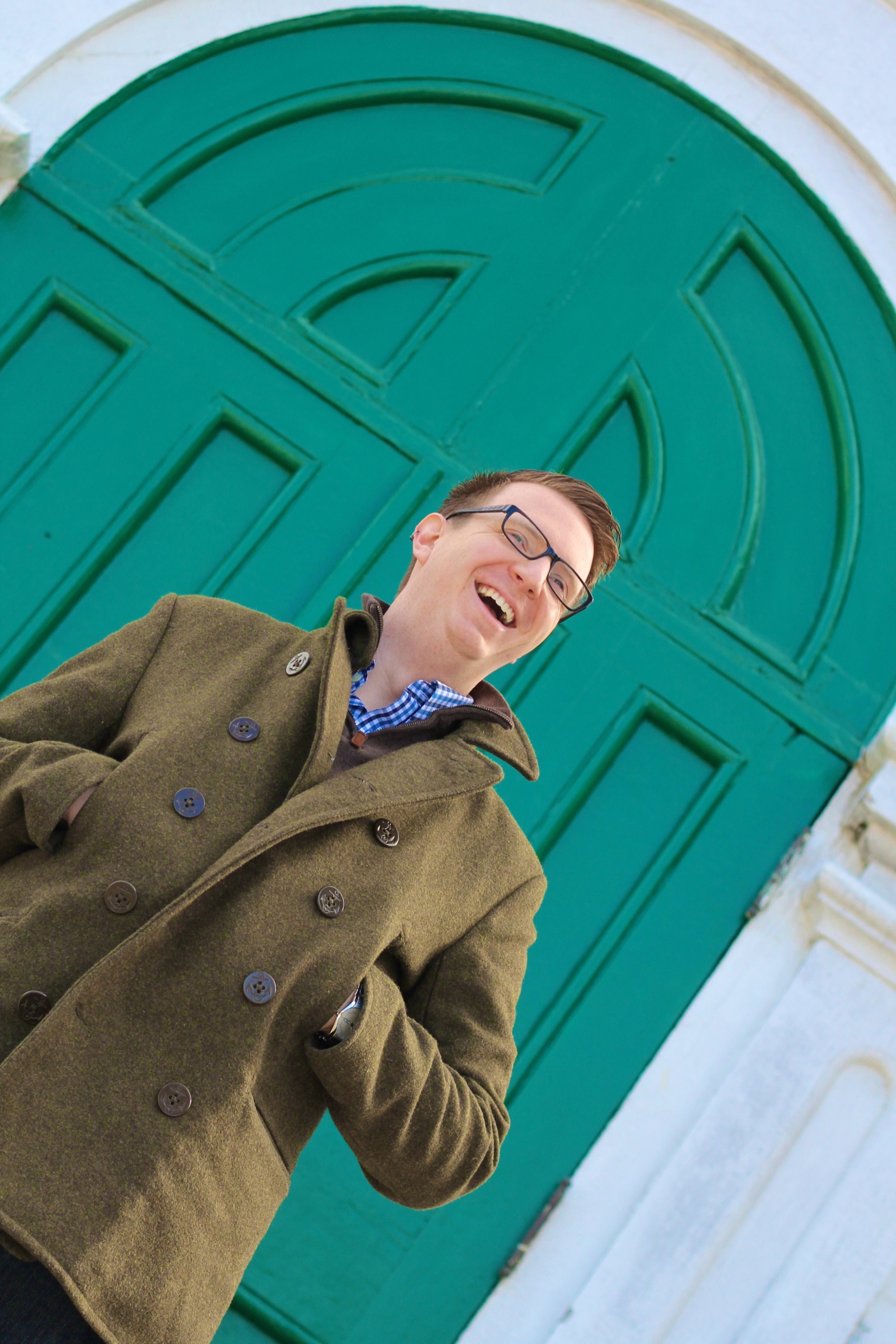
Getting people through the door is the task that every church must consider.  Jonathan has taken that challenge literally. He created a set of six doors in rainbow colors which are placed on the sidewalk outside the church whenever there is a church supper or event or during a town celebration. “Why put your welcome mat inside your front door?” Jonathan asks, “We want the world to know they can come inside.”  The visual invitation is clear and echoes part of Westfield’s hospitality: “everyone, everyone, everyone is welcome here.”

If people accept the invitation, they will encounter a growing congregation with a wide variety of ages. Drawings done by young children hang on the walls where older members tuck their walkers away during worship.  Visitors will see the “altarscapes” that Jonathan creates to visually convey a Scripture story or church season. The white walls of the sanctuary create a blank canvas for Jonathan’s artistic vision. “Fabric is our paint,” he explains, so “we can tell God’s story visually.”

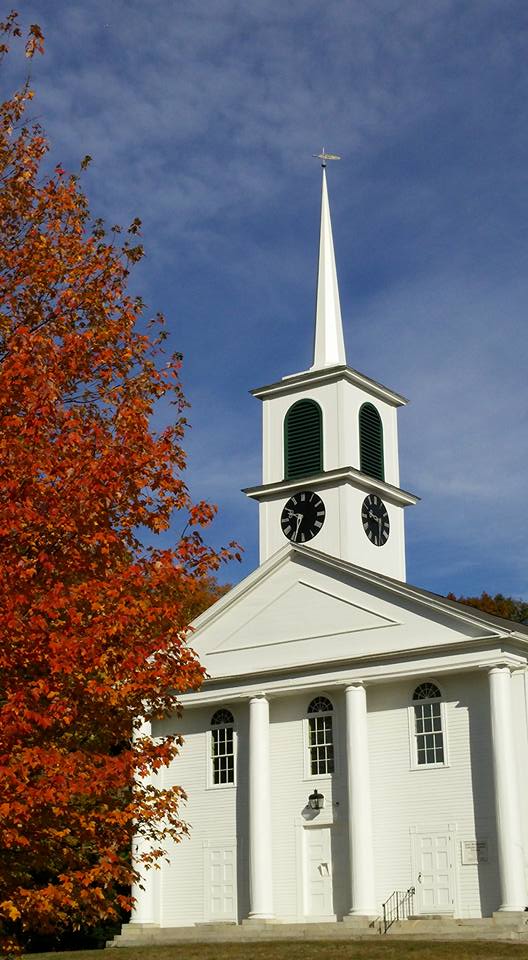
For Jonathan, part of God’s story is one of inclusion and love.  Westfield officially declared their Open and Affirming welcome to all of God’s children in June 2014. Positioned right on Main Street, Jonathan’s goal is to have the church live out its calling to be the heart of the town, sharing God’s love in a variety of creative ways. High above the street, the deep, rich tones of the church bell ring out across the town, sending a message of love, hope and renewal that can draw generations together. Here is Westfield UCC, starting its fourth century of ministry proclaiming the Good News: the doors are open, everyone is welcome, come on in!Westfield doors

What kind of Christian?

I believe

Jesus said: “‘Love the Lord your God with all your heart and with all your soul and with all your mind. This is the first and greatest commandment. And the second is like it: ‘Love your neighbor as yourself.”  Matthew 22: 36-39

There have been a multitude of people who say they are motivated by their faith to engage in actions I often find incomprehensible.  Donald Trump states that he reflects a deep Presbyterian faith. Kim Davis refuses to issue marriage licenses because she is “obeying God’s law.” And then there is the outrageous Westboro “church” that protests at funerals, targeting broken-hearted people with their venom and scorn.

Such claims to Christianity make me cringe. I shake my head and say, “That isn’t what I believe.  I’m not that kind of Christian.”  On the other hand, I refuse to describe myself with a negative or by saying what I am not. Instead I want to consider what I do believe. What kind of Christian am I?

This reminds me of the final paper I had to complete in seminary so many years ago. As a prerequisite to graduation, each of us was required to write our personal “credo” as we attempted to describe and define what we believe.

No matter what faith (or other) tradition you follow, this is a good exercise. It can be helpful to try to articulate what is most important to you – what are your values? What core beliefs define your life? What guides your actions?

So here is my working list.  While God may stay the same yesterday, today, and forever,   my understanding of God changes and evolves as I wend my way through life (I’m avoiding the phrases “grow older” or “age”).  Based on what I know and have experienced up to this point, this is the kind of Christian I yearn and endeavor to be every day.

I am a Christian who…

  • Believes it is all about love. God loves us – all of us, always, unconditionally, with forgiveness and mercy and the opportunity for new life. We are asked to share that love with others.
  • Thinks there is more than one way to know God. I recently saw a bumper sticker that declares, “Prays well with others.” If we could do that, it would solve a lot of problems.
  • Believes God is the God of second chances. God is always ready to forgive, help dust us off, get us back on our feet, and encourage us to try again.
  • Believes we break God’s heart regularly – when we exclude people, when we judge others based on their skin color, when we dismiss people of other cultures, traditions, and religions. I believe God loves us anyway and continually offers us opportunities to learn, grow, and change.
  • Discovers God while I write in my journal, when I go on walks, when I listen to others ponder their faith, when I take time to read and reflect. God is always there and it is my loss when I feel too busy to notice.
  • Is wary of anyone who claims to absolutely know the will of God. People who think they have all the answers make me nervous. If anyone can clearly describe God without doubt or reservation, I suspect that is not God.
  • Believes in prayer, even when I don’t completely understand it. I don’t know why some prayers seem to go unanswered or why the answer is no. But I have witnessed the power of prayer and believe that praying for one another is one of the greatest gifts we can offer.
  • Still has a lot of questions. I don’t know why heartbreakingly bad things happen to perfectly nice people. I am humbled by the grief I have encountered in people’s lives and also in awe by the acts of kindness, love, and compassion I have witnessed.

In the end, I rely on the words of Jesus

  • Love God
  • Love your neighbor
  • Love yourself

Simple words that take a lifetime (and more) to live.

What do you believe?

Conversation with a LGBT Trailblazer: The Rev. Alice O’Donovan

Alice

God says, “I am the Lord your God, the Holy One of Israel, your Savior…You are precious and honored in my sight, and…I love you.” (Isaiah 43)

Do you remember 1988? 

  • The L.A. Dodgers won the World Series.
  • Lloyd Bentson informed Dan Quayle, “Senator, you are no Jack Kennedy.”
  • George Bush assured us, “Read my lips: no new taxes.”
  • Nike told us to “Just do it.”
  • Lemon-flavored Snapple iced tea was introduced.
  • A plane was shot down over Lockerbie Scotland, killing 270 people.
  • Popular movies included Rain Man, Big, and Beetlejuice
  • Some top TV shows were The Cosby Show, Cheers, and Murder, She Wrote.

In 1988, our country was in the midst of the AIDS crisis, a still little-understood disease that was causing terror and panic across the land. By 1988 over 81,000 cases of AIDS had been reported; over 61, 000 people had died.1

In 1988 Alice O’Donovan made history in the Connecticut Conference of the United Church of Christ by being the first openly gay person to be ordained.   It isn’t easy being first. I admire the courage and tenacity that enabled Alice to be a trailblazer and to answer the call to ministry. She was a pioneer and that is never an easy task.

When she and I met recently at a local restaurant to share a delicious lunch of Pad Thai, she reflected on the challenges and blessings of her path to ordination. Even after all these years, the pain and the joy of those memories can bring tears to her eyes.  Along the way she encountered ignorance, intolerance, betrayal, and a myriad of hurtful comments and actions. She also experienced the grace, kindness, care, and encouragement of people who recognized her gifts and supported her calling.

Every time there was a roadblock or challenge to her vision to pursue ordination, God seemed to place a messenger who delivered enough encouragement and grace to enable her to continue.

I am amazed Alice didn’t give up; I am inspired by her faithfulness.  Her home church refused to write the required letter of recommendation for her. The board of deacons instructed the minister to dismiss Alice from their congregation because of her sexuality.  Without a home church, there is no path to ordination.  When the Conference Minister heard about the church’s refusal, he encouraged Alice to persevere because, he said, it was clear that “she had all the requisite gifts to be an excellent minister.”  The Congregational Church in Storrs welcomed her in and invited her to be part of their church family; they were proud to sponsor her as a candidate for ministry.

Then there were the logistical challenges – Alice had to commute over 170 miles each week to take classes at the Episcopal Divinity School in Cambridge. Coming from a busy household with three young children, that seemed completely overwhelming.  A member of her new home church pulled her aside during coffee hour one Sunday. She offered to watch the children and prepare a meal for the time-stretched family every week. This kindly soul looked Alice in the eye and said, “You belong in seminary.” Thank God for people who have both the insight to discern the gifts of others and the practical wisdom to lend a helping hand.

After years of taking classes, writing papers, doing field work, completing requirements, and putting thousands of miles on her car, Alice was finally ready for her Ordination Council.  One minister informed her that he would be attending but planned to vote against her. “It’s too bad,” he said, “you’re so well-qualified and you have all your ducks in a row.  But  you’re gay.”     With that pronouncement on her mind, Alice presented to the Council her paper describing her thesis based on the Apostle’s Creed. The Dean of the Yale Divinity School would later request a copy of her paper to use as an example for future students who needed to clearly define their faith.

The Ordination Council was comprised of a series of questions and answers about Alice’s faith and theology. It also included some who objected to her candidacy and who asked her to declare her sexuality in front of the crowd gathered for that momentous meeting. Finally Alice was asked to go to another room so the community could vote. When she re-entered the sanctuary, the assembly rose to its feet to applaud and cheer as she walked down the long center aisle of the church. Her candidacy had been approved by the voting members, 21-7. Alice O’Donovan could be ordained.

Her first call was to a small, rural church with no running water in Peru, Vermont. In her typical self-deprecating way, Alice maintains that the “minister no one wanted got the church no one wanted to serve.” Yet together they shared the Good News of a God who cares, welcomes, heals, and renews.

In the years since 1988 Alice has served a number of churches.  She compares her different calls as a pastor to the experience of trying on a series of shoes; each successive one fit slightly better than the previous one. I wish her ministry was considered newsworthy simply because she is an excellent preacher and a compassionate caregiver.  Too often, however, it was her sexuality that drew people’s attention.  When she became the pastor of the South Windham (CT) Congregational Church in 1991, the New York Times covered the story and put her picture on the front section of the Connecticut Section.

Alice continues her ministry even as she enjoys semi-retirement. Later in October, she will be the guest preacher when the Westfield Congregational Church in Danielson CT marks its 300th anniversary. Every year she presents a workshop at the True Colors conference, a statewide gathering of LGBTQ youth held on the UConn Campus. She poses the question, “Is the Bible the word of death or the voice of hope for the LGBTQ community?”  She says that the answer to that question is “yes.”

Alice wisely observes that people can prove or disprove almost anything using Scripture; the problem is not God – it is how people misuse the Bible. The most important thing to remember, she says, is that God loves you.  Always.

That has been the ministry of Alice O’Donovan. She has lived out her conviction that all of us are called to serve God.  She says, “Conversion is my favorite game. I want everyone – really, everyone – to know they are loved by God.”   She has watched the world change since 1988 and she has been part of that change. The world – and the church – is a better place because of her compassionate ministry.

1 http://www.amfar.org/thirty-years-of-hiv/aids-snapshots-of-an-epidemic/  Captured October 2, 2015

Bumper Sticker Wisdom

Bumper Sticker Coexist

I love bumper stickers. Those short, pithy sayings that can make me laugh – or think.

One of my favorites questioned, “Where are we going?  And why are we in this handbasket?”  It makes me smile whenever I think about it.

Or the bumper sticker that reads, “Knock, knock.  Who’s there?  Doctor.”  Coming from a family of “Doctor Who” fans, I like the subtlety.

Or the sticker that I saw in traffic the other day, “I’m not lost.  I’m exploring.” It’s a good attitude, even when it isn’t true.

I know people criticize what is often labelled “bumper sticker theology,” the temptation to define complex subjects with the briefest phrase.  But sometimes a short quote can provide much food for thought.

Here’s one that I like:

Love God. Love your neighbor. Save the world. (Episcopal Church)

Now, I know you could argue with that. You might say, “It makes it sound too easy.” If you could engage the bumper sticker in conversation, you might want to raise topics like multi-cultural differences or gun violence or even about that annoying woman who sat next to you on the bus.  But bumper stickers aren’t about dialogues.  At their best, they remind us of what is true.

With just 8 words this bumper sticker describes an entire way of life.  Love God.  That’s first. Then – Love your neighbor. Because that is what God tells us to do.  If we do those two things – which are not easy and which we will fail spectacularly at many times each day – we will change the world.

Try it. Express your love for God through gratitude and thanksgiving.  Take a few moments to think about your blessings today and give thanks.

Try to love your neighbor – not just someone next door, but also the person you live with, or the sullen store clerk, or the over-worked waitress, or micro-managing boss, or your petty cop-worker, the relative who calls too often or who never calls at all…you get the idea.

Those actions, given to God, will change the world. Notice – we don’t have to change the world ourselves (that would be a lot of responsibility). We need to live the way that God tells us and trust that God can use those actions.  God will change the world, with us and through us.

Or – to use another bumper sticker to say it another way:

To believe is to care. To care is to do.  (United Church of Christ).

Let’s not make faith more complicated than it is. Let’s allow God’s love to move us to action.