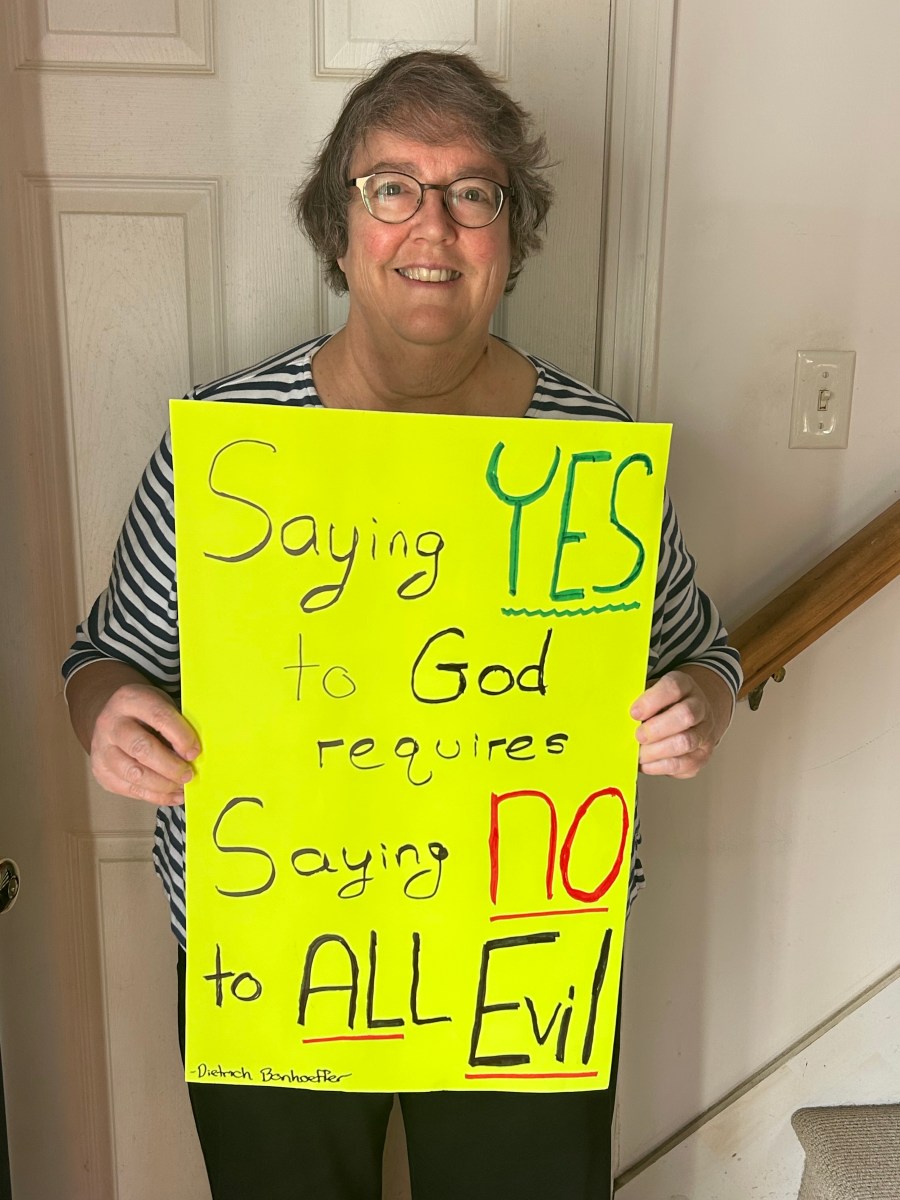
Have sign, will protest

Thank you for all your wonderful suggestions for my sign for the protest on April 5th!

I am inspired by your creativity and your engagement in this ongoing battle to defend our democracy.

Here are the ideas I received from you…

  • Fund Elmo, not Elon
  • Hands off our history
  • DEI is actually a Christian value
  • “Musk and Trump, grandmothers everywhere are ashamed of you! You turned out rotten!”  (quote from Bill McKibben)
  • If empathy is a sin, sin boldly.
  • We don’t want your Nazi cars.  Take a one-way trip to Mars.  (Timothy Snyder BlueSky post)
  • Get your greedy hands off our elections!
  • Let’s put ICE into deep freeze
  • The anti-Robin Hood:  Thief of the needy, benefactor of the greedy
  • I don’t want Greenland or Canada.  I want PBS, Social Security, and the Smithsonian.

I liked all of these.  And then I came across this quote from Dietrich Bonhoeffer: “Your ‘yes’ to God requires your ‘no’ to all injustice, to all evil, to all lies, to injustice, to all oppression and violation of the weak and poor.”  So my sign reads: “Saying YES to God requires saying NO to all evil.”

Since Bonhoeffer, a German Lutheran pastor, bravely stood up to the Nazi regime during a time when too many churches and congregations were silent, he is a role model. His sermons and his letters from prison offer insight and inspiration even now, 80 years later. His deep faith provided him compassion for the millions who suffered under the Nazis and the courage to voice his resistance to Hitler. 

His words speak to me because I believe in a loving God who calls us to care for one another.  And especially to care for those who are outcast, poor, suffering, and too often forgotten.  We are called to do whatever we can – large or small – to help one another.  To ignore the pain around us is evil. 

I want to say “no” to evil. 

I want to say “yes” to God with my words and actions – day by day, moment by moment.

That’s what my sign means to me.  And that’s what I will be sharing during the protest on April 5th.

Let’s stand together and say “no” to evil. 

Sign of support: Patti protesting the firing of so many National Park Rangers:

What do we do now?

Is it just me, or do you also wake up in the middle of the night worrying about the state of our country and the world?

Do you also experience an ache in the pit of your stomach when you imagine the pain and suffering resulting from shutting down USAID payments?

Does it bring tears to your eyes when you read about children going hungry in Columbia, families in Africa dying from discontinued AIDS medications, and displaced civilians in Ukraine having no shelters to offer food and trauma care?

The cruelty and heartlessness of our government leaders (elected and non-elected) is staggering.

Screaming at the radio hasn’t helped.

Neither has slamming my laptop closed when I simply can’t read any more news.

So let’s do this. 

Let’s share ideas.  

What are you doing to respond?

What ideas – big or little or even merely symbolic – do you have to combat the tide of callous indifference that is washing over our country?

This is what I am doing so far: 

  • I installed the app “Five Calls” on my phone.  It provides phone numbers for my senators and state representatives and makes it easy for me to call them to express my outrage and to encourage them to speak up. Phone calls matter.  Five Calls offers sample scripts that I find very useful when I feel under pressure to be eloquent (or at least clear). My experience so far is that the people answering the phones are unfailingly polite, professional, and helpful.  I’m using my voice in this small way and hoping that it will make a difference.  
  • I added my pronouns to the signature of my email.  This is merely symbolic, I know, but I want to stand in solidarity with federal employees who have been forbidden to express their pronouns or to even acknowledge that a spectrum of gender identities exist.
  • I’m supporting organizations doing important work.

My small donations won’t make up for the billions of dollars halted from USAID but I want to do what I can. I’m supporting (among others):

  • Doctors without Borders
  • UNICEF (United Nations Children’s Fund): “UNICEF” is on the ground in 190 countries and territories to save and protect children. Let’s keep this critical work going. 
  • Church World Service is a faith-based organization that works in the United States and across the globe to combat hunger, poverty, displacement and disaster.
  • I also increased my donations to the Public Broadcasting Service (PBS) and National Public Radio (NPR) because I rely on their truthful and non-hyperbolic reporting.

What are you doing?

What are your suggestions about how to help?

Share your ideas in the comments and I will pass them on in a future blog.

It’s important for us to remember that we are not powerless.  

We may not be able to tackle all of the problems but each of us can do something.

Don’t give up!

Ordination Anniversary!

Today I am filled with gratitude.  35 years ago today on January 17, 1988, I was ordained as a Christian minister by the United Church of Christ.

            I am grateful that I was called into ministry.  I was living in Germany at the time, miserable in an office job in a manufacturing company.  Having discovered that I was not cut out for the business world (I never cared how many things we sold or paid attention to increasing productivity), I was searching for direction.  What could I do that might make a difference in the world?  How could I try to help people?  How could I be part of something bigger than myself?

As I mulled over entering ministry, I posted an airmail letter to my parents (it was 1983, long before the internet). Fearing that a declaration about entering ministry might be too shocking, I described wrestling with ideas from teaching to nursing to ministry.  Two weeks later, I received my mother’s reply, “You would be a wonderful minister.”  I am grateful for her faith in me – and for being a role model in living out her own faith.

I quit my job, sold my VW Bug, and headed back to the States. Never mind that I had never met a woman minster or that the majority of Protestant denominations weren’t accepting women ministers, I knew what my direction had to be.

I am grateful to my mentor the Rev. Dr. Bruce Bunker for shepherding me through years of training with countless hours of conversation and guidance.

I am grateful to Lancaster Theological Seminary for providing an educational foundation filled with creativity and community as well as a wide array of hands-on experiences that helped prepare me for parish ministry.

I am grateful for my friends and classmates who accompanied my on the journey through Greek 101 (flashcards, anyone?), introduction to Church History (you too can learn 2000 years of history in 2 semesters!), counseling, sermon preparation (“we have a powerful story to tell – get up and share it!”) and much more.

I am grateful to the East Woodstock Congregational Church for calling me as their pastor in November 1987.  Their faith and confidence in a young, untested seminarian was the confirmation necessary on the journey towards ordination.

I am grateful the First Congregational Church of Wallingford for hosting my ordination. I was baptized and confirmed in that church and attended Sunday School, Pilgrim Fellowship (thanks, Mike Jackson!), and Youth Choir there.  They really raised me in the faith so it was a proper place to celebrate my entry into ministry.  

I am grateful for God’s faithfulness through the ups and downs of a lifetime in ministry. During 35 years, I have confronted unbearable sadness, suffering, evil, and hardship.  And I have experienced compassion, joy, fellowship, transformation, kindness, empathy, forgiveness, and new life. In the end, love wins.  To quote Desmond Tutu, during my ministry I have discovered that “goodness is stronger than evil, love is stronger than hate, light is stronger than darkness, life is stronger than death.”

Today, January 17, 2023 I am so grateful.

What’s in your wallet?

“What’s in your wallet?” – that’s the tagline of a credit card company trying to convince us that we need their product to successfully navigate the world. With this in your wallet, they proclaim, you can face any challenge.

          But that made me wonder – what else do we carry in our wallets?  What hidden treasures are held within this mundane carrying case?

          It reminds me of a time when I was helping my father-in-law fill out a pile of forms necessary to move into assisted living.  They needed lots of information – his driver’s license number, social security number, health insurance number.  Again and again, he would say, “I have that – it’s in my wallet.”  He handed me his wallet to look through.  As I was searching for the information, a small black and white photo dropped out.  It was a picture of his son,  my husband’s older brother who had passed away 15 years earlier.  My father-in-law grabbed the photo and at first looked almost angry, then maybe embarrassed.  Finally, this quiet and private man said to me, “I always carry him with me.”

          Since that time, whenever I encounter someone, I always wonder, “What’s in their wallet?”  What hurts are they carrying with them? Who are they missing? What is private and precious to them? Who is near and dear to their heart – hidden from view but always close to them?

          I try to let that thought influence my behavior when I encounter someone who is rude or surly, withdrawn or distant.  I try to wonder – what’s in their wallet?  What load might they be bearing? What unspoken truths do they carry with them?

          This is where the “love kindness” part of Micah’s dictate (Micah 6:8) comes in. We are commanded to do justice, love kindness, and walk humbly with God.

Every day we encounter many people.  I suspect all of them are yearning for kindness – or at least decency and respect. Every day we meet people who are carrying some burden with them. Without ever knowing what is in their wallet, we can endeavor to treat them with the kindness they deserve.

How do we respond?

How do we respond?

What worries you the most these days?

Is it

  • Gun violence?
  • The repeal of Roe v. Wade?
  • The ongoing division in our country?
  • Racial injustice?
  • The war in Ukraine?
  • Your own family concerns?
  • Health issues?

 There is an abundance of concerns right now in what feels like an ongoing unsettled time in our country. It’s hard to watch the news but it feels somewhat negligent to simply ignore everything going on. What to do?

I don’t have solutions for these complex, heart-rending problems. But I would like to offer some encouragement about tending to our mental and spiritual health while navigating these emotional challenges. I believe we must take care of ourselves so that we can engage in facing these issues and searching for positive solutions.

Here are some steps that might help.

  • Name your fears. Make a list. Get it out of your head and onto paper (or a screen). Otherwise we keep rehashing the same worries; it’s like riding a never-ending rollercoaster of emptions.
  • Acknowledge your concerns.  They are real and they are valid.  Ignoring the issues or pretending that they are not serious will not help. If part of your acknowledgment includes crying out to God and the universe, do it.  Talking about our concerns opens up space in our spirits so that we can be renewed.
  • Replenish your spirit.  We are not alone. We don’t have to rely solely on our strength or wisdom. God promises never to leave us or abandon us. Seek God’s comfort and strength.
  • Go to the well and drink deeply. God’s love is described as streams of living water (John 7). Our spirits are parched by a parade of bad news and heartbreaking events. Before we can address them, we must replenish our energy with God’s renewing hope.

What will that look like for you? How will you seek God’s love and be reminded of God’s presence?  Will you sit quietly, go for a walk, read the Bible, journal, garden, meet with friends to talk and share?  Try different ways of encountering God.

            The problems of this generation will not improve without our efforts. We can remember a wise Jewish saying, “You are not obligated to complete the work, but neither are you free to abandon it.” With God’s help we will receive the strength and comfort we need to navigate each day filled with the reassurance that God is always with us.

Let us pray

I think we can all agree – we live in overwhelming times. The relentless pursuit of the Corona virus in all of its variations, the ongoing war in Ukraine, climate change and reports of evaporating lakes, wildfires, and warming oceans. There is seemingly endless division and conflict amongst our political leaders that trickles down to infect local and state governments. Prices are up. Shortages are growing. Rents are climbing. Affordable housing is difficult to find. Racist violence is rampant.

            Add to that your own personal worries about loved ones, employment, finances, and health. It is no wonder that rates of anxiety and depression are growing in our country.

            What to do?

            How should we respond?

            What’s the best course of action?

            Let us pray.

            I can almost see you rolling your eyes.  Pray?!?  What good will that do? Why should I waste my time muttering words to God?  If God is all-knowing, God doesn’t need my reminders about today’s dismal state of affairs.  If God is all-caring, God shouldn’t require me to convince him to tend to the sick and the dying. If God is all-powerful, God won’t be helped by my encouragement and entreaties.  

            You’re right.

            So much of prayer is not for God’s benefit, but for our own. It is not to convince a grudging, reluctant God to act. Prayer brings our parched spirits to the ever flowing streams of God’s love and presence. We can find renewal there. We can find hope.

            Here’s the invitation – let us pray. We have started gathering on Fridays at noon for prayer. You are invited to join us – in person in our sanctuary or in spirit wherever you happen to be. You can also send me prayer requests.

 This brief service reminds us of what is true – we are not alone as we face the challenges of this world.

            Prayer is an invitation to listen to God’s life-giving words. If we fill our ears solely with the latest news reports and urgent (and often depressing) text/social media messages, our minds and hearts will be filled with despair. Taking time to pray offers moments of quiet and peace in the presence of love. It is not about denying or running away from the truly awful state of affairs. Instead, prayer feeds our spirits so we can be strengthened to act.  

When I take time to listen, I hear assurances like these:

  • God cares deeply for the stranger, supports the widowed and orphaned, and ruins the schemes of the wicked.  (Psalm 146)
  • You know me, God. You know me. You see me working, you see me resting.

You know what I think about; you know what I do.  

You are everywhere – near and far, and all around me. (Psalm 139)

  • Turn from evil, love what is good, and you will be at peace;

God is a lover of justice who will never abandon the faithful.   (Psalm 37)

We are called to respond to the needs of the world. Let us begin with prayer.

Head vs. Heart

During September and October my congregation had eight glorious weeks of outdoor worship on the East Woodstock common. It was the best of both worlds – many people braved the sometimes chilly mornings outside while others enjoyed worshiping with us online. It was delightful each week to receive greetings from across the country and even other parts of the world as we joined our hearts and spirits together to worship and give thanks. We discovered new meaning to Jesus’ promise that, “Where two or three are gathered in my name, there I will be also.”

            But this is New England and outdoor worship is a time- and weather-limited event. Our church council voted that our worship would continue online only for the winter months. To avoid spreading the virus we will not meet in our sanctuary. In March we will evaluate where the world is in terms of health, safety, and the virus. That will guide our decision about how to go forward.

            This is not an easy decision.  My heart tells me, “I love being together with our congregation!” I also love to sing, hug, shake hands, and pass the communion plates from person to person. But my brain tells me, “Right now that is not safe. Right now we need to protect one another by staying distant from each other.”

            Those tough decisions are often followed by long, heartfelt sighs. The pandemic, to put it mildly, is not easy. It has caused great suffering across our country and around the world. It causes us to make difficult choices. It can feel like our hearts are at odds with our brains which is an exhausting experience and a tiring way to live.

            This is when I turn to my favorite Thanksgiving hymn, “Great is your faithfulness.”  We can sing our praise to God because “morning by morning new mercies I see. All I have needed your hand has provided, great is your faithfulness, God, unto me!”

            When my heart yearns for blessings of the past or aches for experiences that are now absent, my brain (and my faith) remind me that God’s steadfast love endures forever. God’s faithfulness is indeed great and will see us through this challenging time. While my heart sometimes drifts towards sadness, my head recalls the Good News that we worship the God of resurrection and new life. Despite all the obstacles we are encountering right now we have not reached a dead end. During this journey through the unknown, God invites us to discover new and different blessings along the way.

            My head rejoices that, “You do not change, your compassions they fail  not.” And that makes my heart glad.  

Be a mustard seed

Jesus said, “Truly I tell you, if you have faith as small as a mustard seed, you can say to this mountain, ‘Move from here to there,’ and it will move. Nothing will be impossible for you.” (Matthew 17:20)

 Do you ever feel overwhelmed these days? The problems facing us are overwhelming. The wildfires out West. The ongoing pandemic. Systemic racism. Political turmoil. An angry and divided country. Not to mention your own personal challenges, worries, and struggles.

            What can we do? It is easy to feel helpless or powerless against such powerful forces. We might convince ourselves that there is nothing we can do. We might convince ourselves that our small effort or our tiny voice will have no impact against such crushing, frightening opposition.

            When the news is unrelentingly bad, we can remember Jesus’ description of a mustard seed. That tiny kernel holds tremendous promise.

Be the mustard seed.

In the face of incivility, name-calling, and callousness, be a mustard seed of kindness and courtesy.

In response to anger and impatience, be a mustard seed of empathy.

When rudeness seems to prevail, be a mustard seed of calm.

When prejudice and fear seem to rule, offer a mustard seed of justice and fairness.

It may not seem like much.  That is the point of Jesus’ message. Our offering doesn’t have to look impressive or showy. God promises to use our gifts, no matter how big or little. And if we have only the smallest particle of faith to offer, go ahead and give that to God. God will do the rest.

            Our only mistake would be to give up. The size of our faith doesn’t matter. We are asked to trust that God will take the tiniest amount of love, hope, faith, mercy, compassion, and good will and bless that. God promises to take our meager offerings and multiply them.

            It may seem like we are tossing a tiny pebble of love into a swirling ocean of hate and turmoil but God says – go ahead! God will use what we offer.

            Go ahead and be that mustard seed of love, listening, and caring. We are encouraged to do what we can and trust that God will bless that effort. And just like in a garden, the results may not be immediately apparent. There may be some waiting involved. We are asked to keep planting, keep working, and keep trusting.  God is at work.

            The only mustard seed that is wasted is the one that is never planted. So go ahead – be a mustard seed. Offer your love, show your compassion, and share your kindness. We are invited to speak, listen, pray, care, and act – and then trust that God will cause those offerings to grow and multiply.

Worrying about the children

I can’t get the children out of my mind. Refugee children in detention centers without soap or toothbrushes and sometimes without beds. Children who have been separated from their parents and who barely have enough to eat. Children forbidden to go outside to exercise or play.

            We didn’t invite them here. These children did not ask to be caught up in this violent and dangerous situation. Many do not want them here (I would urge the wealthiest country in the world to consider its obligation to help those less fortunate but that is an argument for another day). The fact remains – the children are here.  They are in our country. What will we do? The way we respond to the weak and desperate defines who we are as a nation. The world is watching. How will we react?

            When I think about the children in the migration centers, I think of my own children at that young age. I remember vividly how vulnerable they were when they were frightened or lonely or sick. When I think of these migrant children who are alone, cold, and afraid, I imagine them crying without comfort or care being provided.  It breaks my heart and makes me furious in equal measure.

            The argument has turned petty. Withholding toothbrushes? Refusing to allow them to shower or bathe? Rationing soap and confiscating blankets? Some would argue that harsh treatment will discourage additional refugees from entering our country. The idea that people are risking their lives in order to be treated inhumanely in detention centers defies logic. No one is crossing the border to get a clean toothbrush. Desperate parents are trying to save their lives and protect their children. They are risking everything in search of safety, security, and a chance for a new life.   

            Responding to thousands of refugees fleeing from countries filled with violence and danger is a huge challenge. Fear is driving them to our border. Our country needs to take action in this very human crisis. We don’t have to agree on immigration policy before we recognize our obligation to provide basic care for these homeless, hurting children.

Our country was founded by immigrants. We are known as a generous, caring country who rushes to the aid of people across the globe. Now those people are on our doorstep. We may not be able to find homes for all of them, but we can treat them with the dignity that all human beings deserve. If Congress cannot find a way to provide toiletries for children, the government should turn to faith communities and other non-profits. Provide 2000 toothbrushes?  We can do that in a heartbeat.

In the meantime, if you, like me, are looking for a concrete way to respond, you may choose to donate to agencies that are aiding refugees. Here are some:

The Florence Immigrant and Refugee Rights Project  

KIND: Kids in Need of Defense  

UCC Refugee Relief 

            I will pray that we will learn how to put “love your neighbor” into action.

What CAN you do?

A recent foot injury has led to some frustrating restrictions to my mobility. Standing for more than a few minutes is painful. Some of my favorite pastimes have been temporarily eliminated. My morning walks, which feed my spirit and brighten my mood, have been abandoned. Taking care of my flower gardens and communing with the birds as I feed them are put on hold for now.

            As the list of activities that I can’t do seemed to grow longer and longer, I was becoming annoyed and feeling slightly sorry for myself.

            I was lamenting my inability to exercise and enjoy the improving weather when my wise daughter observed, “Well, you could at least lift weights.” And bingo – a new perspective was introduced.  Instead of focusing on the impossible, I was invited to imagine something new.  Given my limitations, what could I do? It was an opportunity to be creative.  I discovered several activities that worked – not only weight-lifting, but also yoga, swimming, biking, kayaking, and stretching. I didn’t need to curl up on the couch in pathetic defeat; I needed to shift my thinking and recognize what I could do.

            Now I’m starting to expand that thinking to other dilemmas and problems. Often when a situation seems overwhelming, I find it easy or tempting to think, “Well, there’s nothing I can do.”  Prejudice against the LGBT community?  Can’t solve that. Systemic racism?  Where would I even start? Global warming? Oceans polluted by plastic? Children being separated by their parents on the border? There are any number of issues, from personal to global that feel unsolvable. It’s tempting to sink into inaction.

            And yet – my new thinking reminds me that I don’t have to come up with a complete answer. I don’t have to produce the entire solution.  I just need to do what I can do. Maybe I can’t change society’s thinking about the LGBT community, but I can march in a Pride Parade or invite conversation with a bumper sticker. I doubt I will overcome centuries of racism and discrimination single-handedly, but I can accept the challenge to educate myself about the experiences of people of color and pledge to recognize moments of racism in myself and others.

            What can I do?  Pick up trash on the side of the road? Greet surly clerks with compassion? Send a card or email to a long-lost friend? What small action might be part of a larger answer?

There may not be a neat solution for every problem. But that isn’t an invitation to inaction. It’s a call (to quote John Wesley) to “Do all the good you can, by all the means you can, in all the ways you can, at all times you can, to all the people you can, as long as ever you can.”