Empathy: Our superpower

Here’s something I never thought I would say:  Elon Musk is right.  He is right when he says that empathy is risky.  He describes empathy as “the fundamental weakness of western civilization” that will lead to “civilizational suicide.”  Empathy is dangerous, he says, because it causes us to give too much of ourselves.  

But Elon Musk is wrong (you knew I’d get there) with the conclusion he draws. He believes that caring for others will harm us – as a nation and as individuals.  If I give of myself and if I care for someone else, it will hurt me.

He used this logic to halt USAID donations that prevented catastrophes such as polio, starvation, AIDS, and malaria, among many other devastating cuts to our national budget. This was behind his reasoning to deny aid to – just one example – the earthquake victims in Myanmar. 

I’m here to encourage empathy – the ability to understand another’s pain. I want to urge compassion – the ability to feel (passion) with (com) another human being.  This is literally what makes us human.

Jimmy Carter demonstrated this when he stated: “I have one life and one chance to make it count for something. I am free to choose that something…My faith demands that I do whatever I can, wherever I can, whenever I can, for as long as I can.”  That led him to public service as governor and President as well as hands-on involvement with Habitat for Humanity.  He lived his faith by caring for others. 

We can do the same.  We must do the same.

When that terrible earthquake hit Myanmar, there was a woman who was five months pregnant and was buried beneath the rubble of a collapsed building.  She was powerless to escape.  There was no way out.  All she could do was hope that someone would care enough to sift through the wreckage.  At that moment, empathy was her only hope. Compassion won that day.  Rescuers found her and both she and her unborn child have been given another chance at life.

Sometimes we are the ones buried by devastation, physical or emotional.  Sometimes we are the ones able to reach out a helping hand.

We are called – commanded – to love one another.  Our lives will be richer – not poorer, Mr. Musk, by our engagement with one another.  As Atticus Finch wisely said in To Kill a Mockingbird, 

“You never really understand a person until you consider things from his point of view…until you climb into his skin and walk around in it.”  We will discover more about others and ourselves when we actively care about each other.

So keep doing those good things that I know you are doing.  Volunteer in the soup kitchen. Be a hospice volunteer. Send cards to people who believe they have been forgotten. Lend a hand to a neighbor.  Offer kindnesses to strangers. Participate in food and clothing drives. Use your unique gifts – your beautiful self – to spread compassion in this world. Go to the protests and defend democracy. 

Believe that your act of caring, however big or small, makes a difference.  Engaging with others and caring about our neighbors is what makes us human and what makes us whole.

We live in a world aching for love and caring.  Let us share these gifts whenever and however we can.  

Quote for today: 

“Like the ancient prophets, we are dispatched back to the work entrusted to us.

It is the work of peace-making.

It is the work of truth telling.

It is the work of justice-doing.

It is good work, but it requires our resolve to stay it, even in the face of forces to the contrary that are sure to prevail for a season.” 

  • Walter Brueggeman 

Sign of Support (each week I share a sign that offers hope for these troubling times)

Have sign, will protest

Thank you for all your wonderful suggestions for my sign for the protest on April 5th!

I am inspired by your creativity and your engagement in this ongoing battle to defend our democracy.

Here are the ideas I received from you…

  • Fund Elmo, not Elon
  • Hands off our history
  • DEI is actually a Christian value
  • “Musk and Trump, grandmothers everywhere are ashamed of you! You turned out rotten!”  (quote from Bill McKibben)
  • If empathy is a sin, sin boldly.
  • We don’t want your Nazi cars.  Take a one-way trip to Mars.  (Timothy Snyder BlueSky post)
  • Get your greedy hands off our elections!
  • Let’s put ICE into deep freeze
  • The anti-Robin Hood:  Thief of the needy, benefactor of the greedy
  • I don’t want Greenland or Canada.  I want PBS, Social Security, and the Smithsonian.

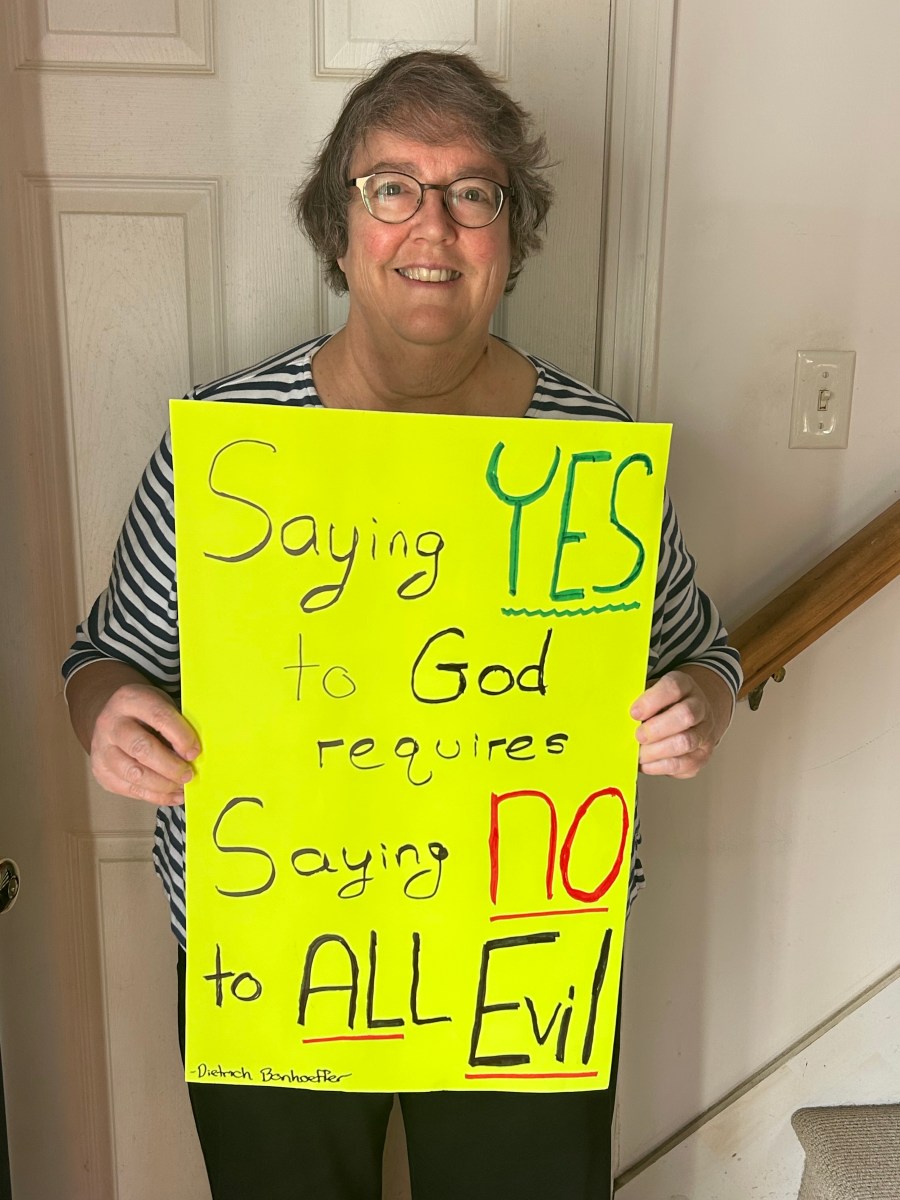
I liked all of these.  And then I came across this quote from Dietrich Bonhoeffer: “Your ‘yes’ to God requires your ‘no’ to all injustice, to all evil, to all lies, to injustice, to all oppression and violation of the weak and poor.”  So my sign reads: “Saying YES to God requires saying NO to all evil.”

Since Bonhoeffer, a German Lutheran pastor, bravely stood up to the Nazi regime during a time when too many churches and congregations were silent, he is a role model. His sermons and his letters from prison offer insight and inspiration even now, 80 years later. His deep faith provided him compassion for the millions who suffered under the Nazis and the courage to voice his resistance to Hitler. 

His words speak to me because I believe in a loving God who calls us to care for one another.  And especially to care for those who are outcast, poor, suffering, and too often forgotten.  We are called to do whatever we can – large or small – to help one another.  To ignore the pain around us is evil. 

I want to say “no” to evil. 

I want to say “yes” to God with my words and actions – day by day, moment by moment.

That’s what my sign means to me.  And that’s what I will be sharing during the protest on April 5th.

Let’s stand together and say “no” to evil. 

Sign of support: Patti protesting the firing of so many National Park Rangers:

What should I say?

I am preparing for the April 5 nationwide protest which will be taking place in every state capital, Washington D.C. and several other cities across the country.

I have my poster board and my markers at the ready.

My question is – what should I say?

Should I focus on my heartache when I hear about lifesaving vaccines no longer being provided overseas?  Or maybe I could channel my outrage at tons of grains and food products sitting in warehouses in the vicinity of thousands of people who are near starvation. Should I write about my grief at the cuts at USAID and the immediate damage that this has done across the globe?

Or should I concentrate on matters closer to home?  The devastating cuts to the National Park Service, for example.  Our National Parks are deservedly a source of national pride and international wonder.  U.S. citizens as well as visitors from across the globe marvel at awe-inspiring vistas and regular sightings of animals large and small.  Cutbacks will reduce park hours, limit the services and programs offered, and inevitably result in a decline in maintenance and protection – not to mention devastate the lives of those faithful, hardworking rangers.

What about the reports of people being detained or deported without due process?  We are told that they are threats to our society but how do we know that if there is no investigation, no trial, and no reports?  Why are people being snatched off the streets by masked “officers”? If I don’t pay attention to moments when “they” are being arrested, I fear that all too soon it could also be “us” or even “me.”

All of that doesn’t even touch on my embarrassment (and horror) at the continued insinuations about taking over Canada or Greenland.  Or the suggestion that Ukraine caused the devastating war they are enduring.  Or our country backing out of world treaties and partnerships that have defined us as a compassionate and strong world leader for decades.

And don’t get me started on my anguish about cutting library budgets and destroying the Department of Education.  Or the threats to Medicaid, Medicare, and Social Security.

All of this seems to be a bit much for my one small poster board.  So – please give me your opinion.  What should I say?  How can I best express my concern?  What are your suggestions for a quote that speaks to this moment?  What needs to be emphasized right now?

Write your suggestions in the comments.  

I’ll show you my sign when I am ready to go to the protest.

“There may be times when we are powerless to prevent injustice, but there must never be a time when we fail to protest.” – Elie Wiesel

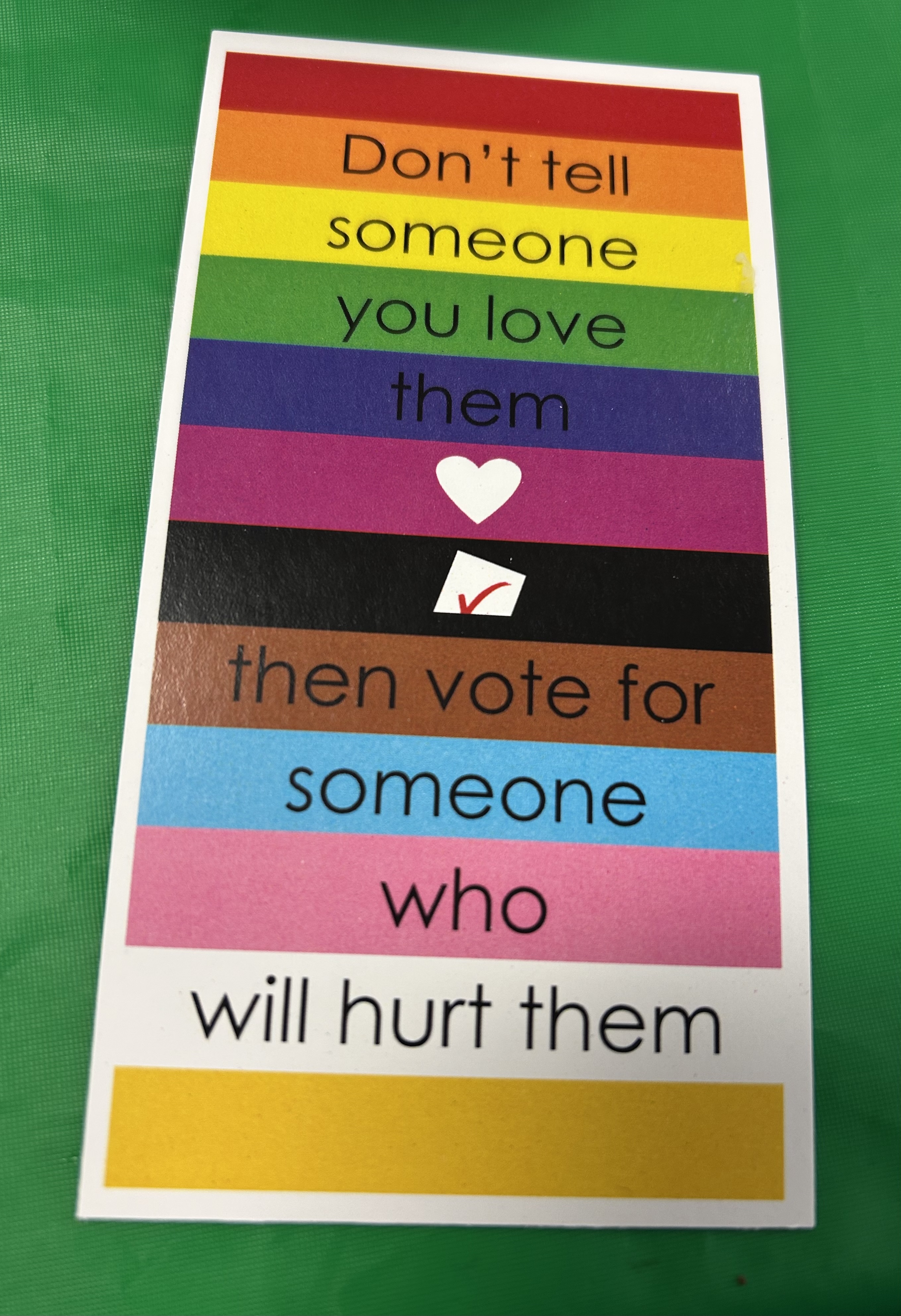
Each week I will be sharing a “sign of support” that I’ve seen in my travels.  This week’s comes from the local Democratic Town Committee supper fundraiser: 

“Don’t tell someone you love them, then vote for someone who will hurt them.”