License to Explore

Instead of reflecting on the horrors and upsets of the day’s news, I’m choosing to share an essay that I recently wrote for a writing class I’m taking. The assignment was to describe an object that reminds us of memories or a story from our lives. Here is my story. I invite you to look around your home and wonder – what objects holds special memories for me? I’d love to hear your stories…

License to Explore: When I look at the 12×12 inch square piece of white sheet metal that hangs on my wall, it reminds me of a tumultuous time of personal growth and adventure. It brings me back to a foundational season in my life that shaped my future.

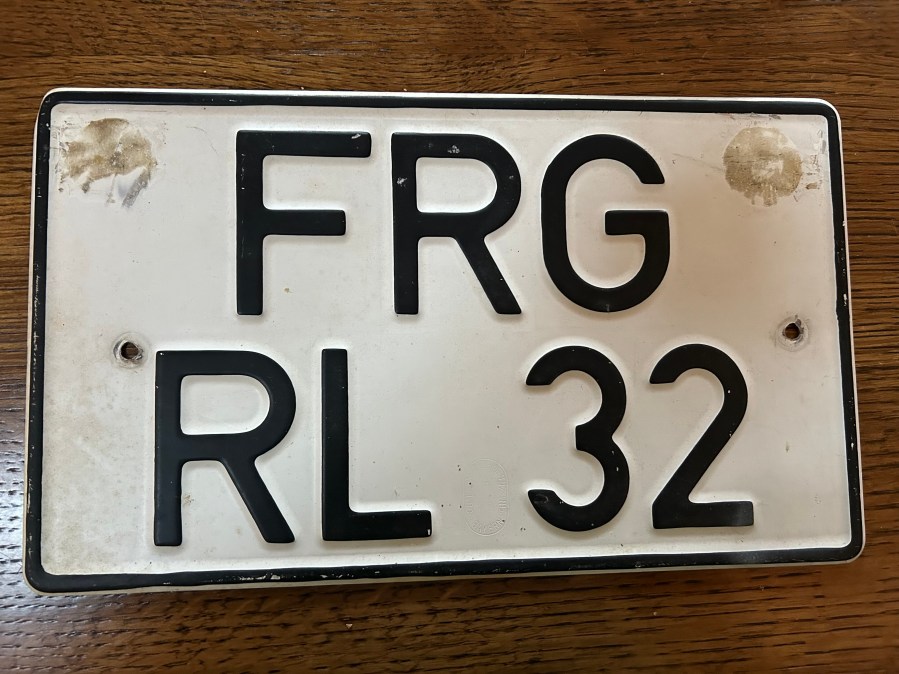
That thin metal plaque is the license plate of the first car I ever bought on my own – a white Volkswagen Bug – when I was 22 years old and living and working in Germany. Looking at the simple design recalls emotions and experiences that would eventually lead to my call into ministry.

The bold black letters at the top – FRG – recall memories of the county (Freyung) where I lived, a rural area in eastern (West) Germany known for its crystal glass manufacturing. I can visualize the utilitarian office where I processed orders with four co-workers overlooking the factory where fabulous pieces of crystal glass were produced.  Through the bank of windows, I could glimpse the glowing furnaces filled with molten glass that were drawn out to form mouth blown sparking lead crystal stemware or funneled into machines churning out thousands of elaborately cut vases, tumblers, and platters. Railroad containers stood at the ready, prepared to be filled and shipped around the world. Right out of college, I had moved abroad to enter the world of international business. 

The license plate is a memento of all those big “firsts” I experienced.  First car (a stickshift!  Another first!), first apartment, first full time job, first serious boyfriend, first time on my own to navigate the wide world. For the first (and last) time, I had six weeks of paid vacation at my disposal, inviting me to adventures in and beyond central Europe. The licence plate stands as a testament to the joy I felt as I considered what seemed to be limitless possibilities.

It also brings back memories of turmoil and despair.  It turned out that I was not cut out for the cutthroat nature of this particular business decades before the “Me Too” movement. The CEO was a vile, crude man who routinely criticized and mocked employees in front of their peers.  He expected me to teach his mistress English so she could accompany him on trips abroad.  Refusing was not an option. Too often people would emerge from his office shaken and in tears while refusing to describe what had been said or done. 

Trips to international conventions that might have been enjoyable opportunities to explore new cities were instead long days of work filled with endless innuendos about after-hours gatherings. I learned to skip dinner and escape back to the safety of my hotel room before the drinking and carousing began.  Before too many months went by it became clear that this was not the life path for me.

The license plate now stands as a symbol of escape. I remember driving my little Bug to the many hiking trails in the area. As I wandered the hills, I poured out my heart to the God I thought I had left behind in childhood.  Long walks gave me the opportunity to wonder where I was supposed to be, what I was meant to do, and how I could make any difference in this world. 

When I look at that license plate, I often wish I could talk with the 22 year old version of myself.  I would offer reassurance that she was not the failure that she believed. I would remind her of the courage it took to go into an unknown situation thousands of miles from home long before cell phones or email.  I would celebrate her strength and resilience as she survived the dissolution of her plans and rejoice in her ability to embark on yet another unknown future. 

What do we do now?

Is it just me, or do you also wake up in the middle of the night worrying about the state of our country and the world?

Do you also experience an ache in the pit of your stomach when you imagine the pain and suffering resulting from shutting down USAID payments?

Does it bring tears to your eyes when you read about children going hungry in Columbia, families in Africa dying from discontinued AIDS medications, and displaced civilians in Ukraine having no shelters to offer food and trauma care?

The cruelty and heartlessness of our government leaders (elected and non-elected) is staggering.

Screaming at the radio hasn’t helped.

Neither has slamming my laptop closed when I simply can’t read any more news.

So let’s do this. 

Let’s share ideas.  

What are you doing to respond?

What ideas – big or little or even merely symbolic – do you have to combat the tide of callous indifference that is washing over our country?

This is what I am doing so far: 

  • I installed the app “Five Calls” on my phone.  It provides phone numbers for my senators and state representatives and makes it easy for me to call them to express my outrage and to encourage them to speak up. Phone calls matter.  Five Calls offers sample scripts that I find very useful when I feel under pressure to be eloquent (or at least clear). My experience so far is that the people answering the phones are unfailingly polite, professional, and helpful.  I’m using my voice in this small way and hoping that it will make a difference.  
  • I added my pronouns to the signature of my email.  This is merely symbolic, I know, but I want to stand in solidarity with federal employees who have been forbidden to express their pronouns or to even acknowledge that a spectrum of gender identities exist.
  • I’m supporting organizations doing important work.

My small donations won’t make up for the billions of dollars halted from USAID but I want to do what I can. I’m supporting (among others):

  • Doctors without Borders
  • UNICEF (United Nations Children’s Fund): “UNICEF” is on the ground in 190 countries and territories to save and protect children. Let’s keep this critical work going. 
  • Church World Service is a faith-based organization that works in the United States and across the globe to combat hunger, poverty, displacement and disaster.
  • I also increased my donations to the Public Broadcasting Service (PBS) and National Public Radio (NPR) because I rely on their truthful and non-hyperbolic reporting.

What are you doing?

What are your suggestions about how to help?

Share your ideas in the comments and I will pass them on in a future blog.

It’s important for us to remember that we are not powerless.  

We may not be able to tackle all of the problems but each of us can do something.

Don’t give up!

“Habit-stacking” or, searching for blessings

“Habit-stacking”

            The term “habit stacking” was introduced to me during a physical therapy session.  The phrase comes from a book by the same title by S.J. Scott.  The theory is that we can add healthy, uplifting habits to our lives if we couple them with already established routines.

            For example, one of the (many) exercises I’m supposed to do at home is squats and heel lifts (going up on your toes to strengthen your calves).  Not surprisingly, I found it challenging to squeeze one more thing into my day – especially something that took effort and hurt.

            My (very athletic, fit) therapist asked me, “What is something that you do every day?  What is part of your daily routine?”  Well, I put lotion on my face every day.  Bingo!  There is an opportunity. Now – couple that habit with another one and you have habit stacking. So now every morning I multi-task – as I apply my lotion, I go up on my toes and bend my knees.  It’s a small change. And it makes a difference. I’m not taking more time out of my day and I’m accomplishing something that is good for me.

            As we prepare to enter the New Year, I am pondering the question – what else would I like to add to my life? It doesn’t only have to be about adding habits that we feel we “should” do.  That sounds too much like the drudgery of New Year’s resolutions that are almost always short-lived. 

Instead, I wonder about blessings and benefits that I could add to my life. How can I increase moments of joy by changing my routine even a little bit?

In the evening before I go to bed, I go to our front door to ensure that it is closed and locked. Recently I have added to that daily habit.  Now I open the door and sometimes I even step out onto the front deck in order to take a moment to look up, gaze at the stars, and notice the moon. In that quiet moment, I feel like I am placing myself and the world into God’s care as I prepare to sleep.  I have “habit stacked” a moment of peace and awe into my life and it is a blessing.

Now I’m wondering if while I’m waiting for my tea water to heat up if I could intentionally take a moment to look out the window and really notice the beauty outside?

Or perhaps as I turn to my computer to tackle the day’s emails, could I pause and wonder who might need to hear from me today?  Can I think of one person who might love to know that I’m thinking about them?

What habits can you stack in this New Year?

What small moments might enrich our lives or the lives around us?

In every moment, we are promised that the God of yesterday, today, and tomorrow is with us.  We are invited to be aware and give thanks.

Blessings in the New Year…

Ordination Anniversary!

Today I am filled with gratitude.  35 years ago today on January 17, 1988, I was ordained as a Christian minister by the United Church of Christ.

            I am grateful that I was called into ministry.  I was living in Germany at the time, miserable in an office job in a manufacturing company.  Having discovered that I was not cut out for the business world (I never cared how many things we sold or paid attention to increasing productivity), I was searching for direction.  What could I do that might make a difference in the world?  How could I try to help people?  How could I be part of something bigger than myself?

As I mulled over entering ministry, I posted an airmail letter to my parents (it was 1983, long before the internet). Fearing that a declaration about entering ministry might be too shocking, I described wrestling with ideas from teaching to nursing to ministry.  Two weeks later, I received my mother’s reply, “You would be a wonderful minister.”  I am grateful for her faith in me – and for being a role model in living out her own faith.

I quit my job, sold my VW Bug, and headed back to the States. Never mind that I had never met a woman minster or that the majority of Protestant denominations weren’t accepting women ministers, I knew what my direction had to be.

I am grateful to my mentor the Rev. Dr. Bruce Bunker for shepherding me through years of training with countless hours of conversation and guidance.

I am grateful to Lancaster Theological Seminary for providing an educational foundation filled with creativity and community as well as a wide array of hands-on experiences that helped prepare me for parish ministry.

I am grateful for my friends and classmates who accompanied my on the journey through Greek 101 (flashcards, anyone?), introduction to Church History (you too can learn 2000 years of history in 2 semesters!), counseling, sermon preparation (“we have a powerful story to tell – get up and share it!”) and much more.

I am grateful to the East Woodstock Congregational Church for calling me as their pastor in November 1987.  Their faith and confidence in a young, untested seminarian was the confirmation necessary on the journey towards ordination.

I am grateful the First Congregational Church of Wallingford for hosting my ordination. I was baptized and confirmed in that church and attended Sunday School, Pilgrim Fellowship (thanks, Mike Jackson!), and Youth Choir there.  They really raised me in the faith so it was a proper place to celebrate my entry into ministry.  

I am grateful for God’s faithfulness through the ups and downs of a lifetime in ministry. During 35 years, I have confronted unbearable sadness, suffering, evil, and hardship.  And I have experienced compassion, joy, fellowship, transformation, kindness, empathy, forgiveness, and new life. In the end, love wins.  To quote Desmond Tutu, during my ministry I have discovered that “goodness is stronger than evil, love is stronger than hate, light is stronger than darkness, life is stronger than death.”

Today, January 17, 2023 I am so grateful.

Sabbatical time

My congregation and I are about to embark on the very special experience of “sabbatical.” What is sabbatical, you may ask?

            A sabbatical is a time to step back and experience something new. The tradition of sabbatical is grounded in the Bible when God gives these instructions, “Speak to the people of Israel and say to them, When you come into the land that I give you, the land shall keep a Sabbath to the Lord. For six years you shall sow your field, and for six years you shall prune your vineyard and gather in its fruits, but in the seventh year there shall be a Sabbath of solemn rest for the land, a Sabbath to the Lord (Leviticus 25).

            God was telling Moses that the Promised Land would need a time of rest and renewal – a sabbatical – to ensure its health and productivity. The word “sabbatical” has the same root as “Sabbath.” We are commanded to take a weekly Sabbath; this time of rest and renewal is a gift from God. (This commandment is probably the one that gets broken most often). We live in a society that values staying busy and multi-tasking and being productive. But God knows that we all need time to rest, breathe, take a step back, and get a different perspective. We all need Sabbath time.

A sabbatical is an extended Sabbath. In our congregation, after six years of ministry, the congregation and minister engage in sabbatical time. We will spend time apart from one another; when we come back together we will have new experiences, insights, and learnings to share with each other.

When I look at my calendar for the coming months, much of it is blank. It offers intentionally unplanned and unstructured time to renew my spirit. I imagine days of reading, biking, kayaking, knitting, and simply sitting outside enjoying God’s creation. During my sabbatical I will also have the chance to visit family and friends – something that is especially sweet after our pandemic isolation. Roger and I will also be traveling to Anchorage Alaska where we will spend some weeks volunteering part-time at a homeless shelter.

            It is also sabbatical time for our congregation. They will have the opportunity to learn and grow under the leadership of Danielle Arnett Keller, our substitute minister. Her experience, enthusiasm, and abundant good ideas will provide our congregation new ideas and perspectives.

            Sabbatical – like Sabbath – does not last forever. It is meant to be a transformative experience that helps us return to our schedules and responsibilities with renewed energy, fresh enthusiasm and increased knowledge.

            I won’t be posting in my blog during my sabbatical – taking a break! – but I’ll let you know what I experienced when I return.  

A Psalm for Every Season

We are listening to to the beautiful book of Psalms in worship during the season of Lent. The psalms are a collection of songs used by the people of Israel as they worshiped in the Temple and in their homes. The psalms encouraged them to – as Paul would say centuries later – pray without ceasing. They were encouraged to speak to God no matter what was going on. And since their lives – like our lives – had ups and downs and joys and challenges, it meant that there needed to be a wide variety of psalms.

Life can get messy sometimes. Too often when people hear the word “prayer,” they think that our words need to be sweet and joyful and filled with prayer.  The psalms offer us words for those other times in life. It turns out that there truly is a psalm for every season of our lives.

The psalms can offer us words when we don’t know what to say to God. The psalms encourage us to pray honest, heartfelt prayers.

  • Feeling exhausted? Read Psalm 38 which complains, “My strength has failed me.”
  • Filled with anxiety? Rest a moment with Psalm 131 as you pray, “Help me quiet and calm my soul,” and be comforted by the images of God as a loving mother.
  • Guilt-ridden?  Psalm 51 is for you. We can offer our confession knowing that God is filled with “abundant kindness” and “steadfast love.” God can create in us a clean heart.
  • Sad? Brokenhearted? Don’t hide those emotions away. Pour out your feelings with the psalmist, “How long must I wrestle with my thoughts and every day have sorrow in my heart?” Pray that as long as you need to until you encounter what the psalmist finally found – God’s “unfailing love.”
  • Need a place to rest and hide away? Turn to Psalm 23 and be reminded of God’s quiet pastures and guidance through the dark valleys. Open your heart to God so that God may “restore your soul.”

And that’s just a tiny glimpse of the richness of the Psalms! Whatever we are feeling or experiencing, there is a Psalm for that.

What an amazing gift – God wants our honest prayers. If we only pray “pretty prayers,” that sound good but ignore what is on our hearts, we miss the healing and help that God offers. The Psalms can help us make our way through the joy, confusion, celebration, trials, and beauty of our lives and offer us the reminder that our Good Shepherd (Psalm 23) is with us every step of the way.

Glimpses of Advent

Where do you see God?  Advent tells us we should be looking.

Where do you hear God’s voice? Advent tells us we should be listening.

Where is God breaking through into our ordinary lives? Advents reminds us that is God’s promise.

        My Advent discipline (actually “discipline” is too strong a word.  Maybe “practice” or even “pleasure” is a better fit) is to notice. Notice glimpse of Advent and reminders of God’s presence. Advent invites me to

            Notice things that make me smile like the cat curled up in my nativity scene.

            Notice joy amidst all the sadness.

            Notice light in the middle of darkness.

            Notice music that makes my heart sing.

            Notice ornaments that remind me of loved ones.

Advent is a season to notice the big and small signs of God. Advent promises that God is Emmanuel – always with us. But it’s up to me to notice. So this year, I’m trying to be intentional about looking and noticing.

            It’s waking up after a snowstorm and noticing that my neighbor already plowed out our driveway.

            It’s coming to work and finding a package of chocolates with the note, “These have quinoa in them so I figured they must be health food.  Enjoy!”

            It’s seeing the sunlight glistening on the snow, the stars shining in the cold night sky, and tiny bits of snow clinging onto the branches.

            It’s a family member calling to chat and catch up.

Even in the pandemic, days get busy and time passes in the blur. Unless I really try to notice these gifts, these flashes of grace, these moments of joyful hope – they will pass me by and I will miss them.

            There is an abundance of sorrow and despair in our world. That makes noticing glimpses of Advent even more important. It provides me with reminders that lift my spirits. These glimpses are like a heavenly whisper reminding me, “You are not alone.”

            Advent is a time to take heart and to hold fast to God’s promises of presence and comfort. You can see my daily record of Advent glimpses on my Facebook page. Where will you catch a glimpse of God today?  

Head vs. Heart

During September and October my congregation had eight glorious weeks of outdoor worship on the East Woodstock common. It was the best of both worlds – many people braved the sometimes chilly mornings outside while others enjoyed worshiping with us online. It was delightful each week to receive greetings from across the country and even other parts of the world as we joined our hearts and spirits together to worship and give thanks. We discovered new meaning to Jesus’ promise that, “Where two or three are gathered in my name, there I will be also.”

            But this is New England and outdoor worship is a time- and weather-limited event. Our church council voted that our worship would continue online only for the winter months. To avoid spreading the virus we will not meet in our sanctuary. In March we will evaluate where the world is in terms of health, safety, and the virus. That will guide our decision about how to go forward.

            This is not an easy decision.  My heart tells me, “I love being together with our congregation!” I also love to sing, hug, shake hands, and pass the communion plates from person to person. But my brain tells me, “Right now that is not safe. Right now we need to protect one another by staying distant from each other.”

            Those tough decisions are often followed by long, heartfelt sighs. The pandemic, to put it mildly, is not easy. It has caused great suffering across our country and around the world. It causes us to make difficult choices. It can feel like our hearts are at odds with our brains which is an exhausting experience and a tiring way to live.

            This is when I turn to my favorite Thanksgiving hymn, “Great is your faithfulness.”  We can sing our praise to God because “morning by morning new mercies I see. All I have needed your hand has provided, great is your faithfulness, God, unto me!”

            When my heart yearns for blessings of the past or aches for experiences that are now absent, my brain (and my faith) remind me that God’s steadfast love endures forever. God’s faithfulness is indeed great and will see us through this challenging time. While my heart sometimes drifts towards sadness, my head recalls the Good News that we worship the God of resurrection and new life. Despite all the obstacles we are encountering right now we have not reached a dead end. During this journey through the unknown, God invites us to discover new and different blessings along the way.

            My head rejoices that, “You do not change, your compassions they fail  not.” And that makes my heart glad.  

Corona in Seville

Guest Post from the Rev. Dr. Mary Luti

Mary Luti has been in Seville, Spain for several weeks and has been writing daily reports describing life in a country that is shut down.

Spain Lockdown Report, Day #33
The unknown makes us afraid, and fear makes us cruel.

Unclean, unclean
The illness caused by COVID-19 is terrible, and too often lethal, but there are worse ways to be sick. Ask the doctor in Barcelona who went down to the garage to get his car and head to the hospital for another grueling shift, only to find it spray painted with the words, “Infectious Rat!”

There are worse infections than COVID-19. Consider the check-out clerk in Cartagena who came home to find a note tacked to her apartment door that read: “We are your neighbors, and we are asking you, for everybody’s good, that you look for somewhere else to live while this is going on, since we know you work at a supermarket, and a lot of people who live here don’t want to run the extra risk you pose.”

There are worse things to fear than this virus. Ask the nurse in Alcázar de San Juan whose anonymous neighbors posted this request: “Hi, neighbor. We know all about the great work you’re doing in the hospital and we’re grateful for it, but you should also be thinking about your neighbors. There are children and old people living here. There are places on the other side of town where they’re putting up health workers. While this is going on, we ask you to think about going there.”

Or the emergency room physician in A Coruña who smelled bleach as he got off the elevator in his condo building. It got stronger as he got closer to his apartment. A couple of his neighbors were disinfecting the area around his door, just to be sure.

In one small town a local butcher was on the receiving end of several anonymous letters, accusing him of infecting people. When the mayor found out, she started a Facebook campaign to support him. She wrote: “There are many good things that will be remembered with gratitude once this is over. Beautiful things, caring gestures, empathy and support. But this will also be remembered. We can’t forget the pain it caused. It’s awful. We won’t forget it. We need to remember what can happen to us when we are afraid.”

Other people have rallied around, too, especially people living in those buildings where the anonymous signs were posted. Different signs are now appearing in the common areas, like this simple one in Murcia that announces in big red letters, “A hero lives here,” followed by more than 50 signatures.

Another supportive sign says: “We are your neighbors and we want to ask you, for the good of all:

–That you don’t lose heart, because our health, our food, our elders, are in your hands…

–That you don’t forget that you are our pride, that half of us would never have the courage to do what you’re doing every day while the rest of us stay home…

–That you don’t hesitate to ask us for anything you need to lighten your load…

and finally, to everyone who would refuse to share life and space with doctors, nurses, health workers, food preparers, checkout clerks, bus drivers, taxi drivers, firefighters, police, etc., etc., we say: Remember, there is no sickness worse than not having a heart.”

The authorities are investigating to see whether these incidents are prosecutable. “To be sure, they are few and far between,” a spokesperson for a national nursing association said, “but they are reprehensible all the same.”

Mary Luti is a long time seminary educator and pastor, author of Teresa of Avila’s Way and numerous articles, and founding member of The Daughters of Abraham, a national network of interfaith women’s book groups.

“Excitement” – Part One

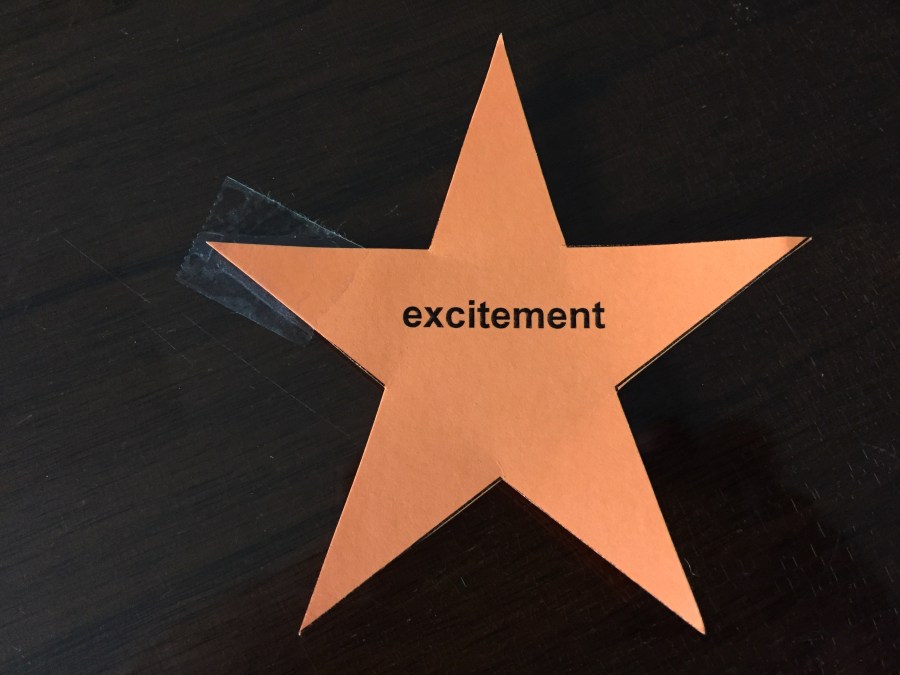
On Epiphany Sunday I received my star word – “excitement.”  Everyone in our congregation is invited to reflect on one of 150 words. During the coming year we can ponder what God might be saying to us. How will God’s light be reflected through this simple paper star and how will it encourage us to be more aware of God’s presence in our lives?

I have an entire year to consider what the word “excitement” might be inviting me to do, learn, and experience. I have to admit, I was thrilled when I flipped the star over and “excitement” appeared. Even as a pastor in a small town in the Quiet Corner of Connecticut, it seems to me that the possibilities are endless.  I’m being invited to experience excitement! It may not be heart-pounding, dare-devil activities. I’m not sure sky diving is in my immediate future. But I can choose and seek things that make me laugh or bring me joy. I can take time to discover what brings a smile to my face and offers me a sense of satisfaction and that feeling of  “I’m glad I did that.” 

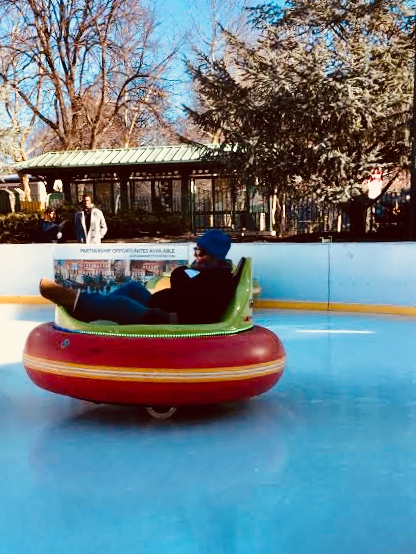
So far I have tried “bumper boats” (if you’ve never heard of it, I recommend it!  I couldn’t stop laughing!), I helped host a benefit concert in our sanctuary, and attended a talk about bald eagles in Connecticut followed by a thrilling walk where an eagle flew right by us! Last weekend my husband and I ventured out for a frosty walk at our local park and watched the ice fishermen bundled up in the cold. I have to admit, my adventurous spirit stopped at the shoreline, so I didn’t join them out on the ice, but I loved walking through the quiet woods and listening to the dramatic cracking and creaking of the ice responding to sunlight and temperature changes.

Since we worship a Creator with unlimited imagination, I’m looking forward to what the year will hold. Here’s to new adventures!

As fun as that is, I’m not sure that God means to be my tour guide through an endless array of new experiences. This word could also be inviting me to explore the excitement of learning new things. I have set myself a goal to learn more about racism – what it is and how it affects people. I think this will be “exciting” because it will expand my mind and introduce new ideas and thoughts. I suspect it will also be challenging because there is much I do not know; I anticipate that it will be humbling and eye-opening. It can be good to learn just how much I have to learn.

I have not accomplished as much in this part of my “excitement.” So far I signed up for a discussion group about the book Waking up White by Debby Irving which promises to be enlightening. I watched the movie “Green Book,” which I highly recommend; it is both entertaining and educational. Once again, I was astounded by how much of our own country’s history I do not know.

I have a whole year to enjoy “excitement” in whatever form it comes to me. I believe God is always inviting us to be more aware – aware of blessings, of God’s presence, of what we have yet to learn.  I’ll let you know how it’s going.

And – if you have a star word, I’d love to hear what it has meant to you so far this year.

If you would like a star word, just let me know and I’ll send you one.