What should I say?

I am preparing for the April 5 nationwide protest which will be taking place in every state capital, Washington D.C. and several other cities across the country.

I have my poster board and my markers at the ready.

My question is – what should I say?

Should I focus on my heartache when I hear about lifesaving vaccines no longer being provided overseas?  Or maybe I could channel my outrage at tons of grains and food products sitting in warehouses in the vicinity of thousands of people who are near starvation. Should I write about my grief at the cuts at USAID and the immediate damage that this has done across the globe?

Or should I concentrate on matters closer to home?  The devastating cuts to the National Park Service, for example.  Our National Parks are deservedly a source of national pride and international wonder.  U.S. citizens as well as visitors from across the globe marvel at awe-inspiring vistas and regular sightings of animals large and small.  Cutbacks will reduce park hours, limit the services and programs offered, and inevitably result in a decline in maintenance and protection – not to mention devastate the lives of those faithful, hardworking rangers.

What about the reports of people being detained or deported without due process?  We are told that they are threats to our society but how do we know that if there is no investigation, no trial, and no reports?  Why are people being snatched off the streets by masked “officers”? If I don’t pay attention to moments when “they” are being arrested, I fear that all too soon it could also be “us” or even “me.”

All of that doesn’t even touch on my embarrassment (and horror) at the continued insinuations about taking over Canada or Greenland.  Or the suggestion that Ukraine caused the devastating war they are enduring.  Or our country backing out of world treaties and partnerships that have defined us as a compassionate and strong world leader for decades.

And don’t get me started on my anguish about cutting library budgets and destroying the Department of Education.  Or the threats to Medicaid, Medicare, and Social Security.

All of this seems to be a bit much for my one small poster board.  So – please give me your opinion.  What should I say?  How can I best express my concern?  What are your suggestions for a quote that speaks to this moment?  What needs to be emphasized right now?

Write your suggestions in the comments.  

I’ll show you my sign when I am ready to go to the protest.

“There may be times when we are powerless to prevent injustice, but there must never be a time when we fail to protest.” – Elie Wiesel

Each week I will be sharing a “sign of support” that I’ve seen in my travels.  This week’s comes from the local Democratic Town Committee supper fundraiser: 
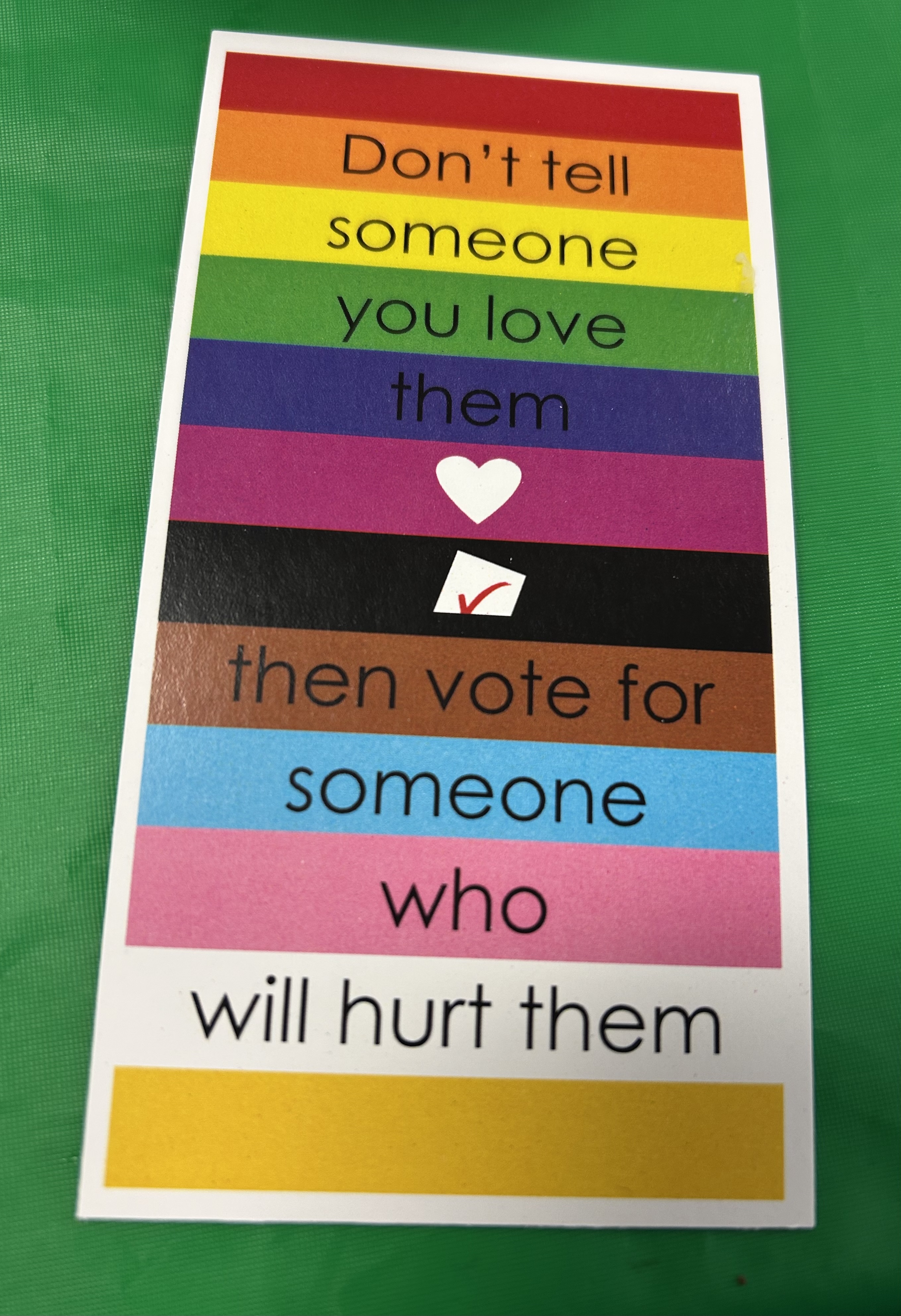
“Don’t tell someone you love them, then vote for someone who will hurt them.” 

Say it out loud

The very wise Rev. Dr. Mary Luti recently encouraged congregations to consider regularly saying together what they believe. In our denomination, the United Church of Christ, it is often not a weekly practice to read a statement of faith or a creed to proclaim our shared beliefs. Mary Luti says that now may be exactly the time to declare those time-tested wise words aloud and remind ourselves of our foundational beliefs. Instead of allowing our faith to “devolve into generalized emotions and good ethical intentions”, congregations need to clearly state what they believe and then proclaim that belief with their actions. 

What is true for congregations is also true for individuals.  Listening to the news  these days is like receiving one gut punch after another. Government institutions and practices that we thought we could “always” rely on are being dismantled. In the face of a rapidly changing world, where it feels like the foundation is being eroded beneath us, it is vital for each of us to declare what is unchanging and true. 

For me, short, easy to remember statements work the best.  At those moments when despair threatens to overcome me, I rely on these brief sentences to bolster my faith and push back my fear. There are still moments when I weep in despair and frustration, but I regularly return to these ancient words of assurance. 

Now is the time to develop a list of readily accessible words to whisper or shout as we declare our refusal to give up.

Here are some of mine:

God’s steadfast love endures forever. (Psalm 136)

The light shines in the darkness and the darkness cannot overcome it.  (John 1:5)

God is love.  (1 John 4)

God is our refuge and our strength, an ever present help in times of trouble. (Psalm 46)

On the surface, saying (and believing) these words solves nothing.

Terrible things still happen.  Appalling headlines still appear. 

There are powerful people who apparently don’t care about millions of people who are suffering because of their actions. 

This practice of saying out loud what I believe is for my benefit and personal wellbeing. It grounds me in a truth larger than the one in the headlines. It tells me that my identity cannot be taken away, despite outside circumstances.

Saying what I believe – reminding myself that God is a refuge in this storm – provides me a moment to pause, breathe, and gain some balance before I try to venture on.

This is a new intention for me – to daily say out loud what I believe so that I am empowered to act on that. 

Now I am curious – what words, phrases, quotes, or images help you?

When to avoid church

Much has been written about Bishop Mariann Budde’s sermon to the newly elected President on January 21st. Now the recently presented House Resolution 59 whines that her words from the pulpit were a display of “political activism” and should be condemned.

There is a simple solution for those who don’t wish to hear the Gospel of Jesus Christ proclaimed  – don’t go to church.

If you don’t want to hear Jesus’ command to care for the least of these, skip church that day.

If you would rather not know that all of God’s people are expected to act justly and to love mercy and to walk humbly with our God (Micah 6:8), by all means avoid the faith communities who proclaim that ancient truth.

If you don’t want to be reminded that all of us are called to care for the stranger and welcome the foreigner, then you should absolutely give communities of faith a pass.

Just don’t go into a place of worship and imagine that you can dictate which words should be spoken that day. 

Holy Scripture in every tradition calls us – commands us – to share God’s compassion especially with those most in need.  That truth must be proclaimed to the people in attendance so that they will be inspired to embody God’s love with their actions.

So – 

If you are looking for inspiration in these wearying days of bad news – go to church.

If you yearn to be reminded that you are not alone even while our leaders try to isolate and divide us – find a place of worship that fills your spirit with hope.

If you need to be assured that you are created in the image of God and loved by God just the way that you are today – find people who are proclaiming this life-giving Good News.

There are many churches, synagogues, and mosques who are living God’s words of hope – search for them.  Support them. Become part of a congregation because we are always stronger together.

Here is a way to find a church in my tradition (United Church of Christ) in southern New England:

Gather with the people of God.

Be inspired by God’s Word that proclaims peace, justice, and hope.

Go out into the world and share God’s mercy and love.

Trust

I do not believe that everything happens for a reason. I have witnessed – and perhaps you have, as well – too many awful events to believe that God is directing those circumstances.  I have seen people’s lives disrupted, plans ruined, hopes crushed, and futures dismantled by accidents, illness, and sometimes just plain evil. It would be a cruel God who would cause a horrific accident or a child’s illness or a devastating historical event in order to teach us a lesson. And I don’t believe in a cruel God. 

So that means that some things – often, many things – are beyond my understanding.  I do not have a satisfying answer to the question, “Why?”  Why do plans fall apart? Why do dreams get destroyed?  Why do the innocent so often suffer?

I do believe in a loving God who promises to show up.  I believe in the God of presence.  I believe God when God vows, “I will always be with you until the end of the age.” 

Lately I have been reflecting on some Bible passages about trust:

  • Trust in the Lord with all your heart and lean not on your own understanding.   (Proverbs 3:5)
  • When I am afraid, I put my trust in you.  Psalm 56
  • Trust in the Lord forever, for the Lord God is an everlasting rock.   Isaiah 26:4

Sometimes – often – things do not go as planned.  The future may appear murky. I am invited to place my trust in God – not because God is dictating every aspect of my life but because God has promised never to leave me or abandon me.

That means when I am facing daunting challenges, I trust that I won’t do it alone.  God has promised to be there when I need God most.

Life is not neat and tidy.  Personally, I cannot discover a reason for many events in my own life or in the world around me.  But I trust that God is on this journey with me. God offers strength and comfort. God invites me into renewing times of rest. God assures me that I can ask for help – from God and from the people God has placed in my life.

I trust that God is bigger than the overwhelming events in the world.

I trust that God’s strength will provide me the ability to go forward.

I trust that God’s wisdom can lead me through a maze of difficulties.

I trust that when I have reached my limit, I can turn everything over to God.  I don’t have to have all the answers.

I trust that when I fail, God will help me begin again.

I trust that God will always love me. 

And that will be enough, one day at a time.

PS: I commend Kate Bowler’s book Everything Happens for a Reason (and other lies I’ve loved) as well as her website www.katebowler.com


How do we respond?

How do we respond?

What worries you the most these days?

Is it

  • Gun violence?
  • The repeal of Roe v. Wade?
  • The ongoing division in our country?
  • Racial injustice?
  • The war in Ukraine?
  • Your own family concerns?
  • Health issues?

 There is an abundance of concerns right now in what feels like an ongoing unsettled time in our country. It’s hard to watch the news but it feels somewhat negligent to simply ignore everything going on. What to do?

I don’t have solutions for these complex, heart-rending problems. But I would like to offer some encouragement about tending to our mental and spiritual health while navigating these emotional challenges. I believe we must take care of ourselves so that we can engage in facing these issues and searching for positive solutions.

Here are some steps that might help.

  • Name your fears. Make a list. Get it out of your head and onto paper (or a screen). Otherwise we keep rehashing the same worries; it’s like riding a never-ending rollercoaster of emptions.
  • Acknowledge your concerns.  They are real and they are valid.  Ignoring the issues or pretending that they are not serious will not help. If part of your acknowledgment includes crying out to God and the universe, do it.  Talking about our concerns opens up space in our spirits so that we can be renewed.
  • Replenish your spirit.  We are not alone. We don’t have to rely solely on our strength or wisdom. God promises never to leave us or abandon us. Seek God’s comfort and strength.
  • Go to the well and drink deeply. God’s love is described as streams of living water (John 7). Our spirits are parched by a parade of bad news and heartbreaking events. Before we can address them, we must replenish our energy with God’s renewing hope.

What will that look like for you? How will you seek God’s love and be reminded of God’s presence?  Will you sit quietly, go for a walk, read the Bible, journal, garden, meet with friends to talk and share?  Try different ways of encountering God.

            The problems of this generation will not improve without our efforts. We can remember a wise Jewish saying, “You are not obligated to complete the work, but neither are you free to abandon it.” With God’s help we will receive the strength and comfort we need to navigate each day filled with the reassurance that God is always with us.

Be a mustard seed

Jesus said, “Truly I tell you, if you have faith as small as a mustard seed, you can say to this mountain, ‘Move from here to there,’ and it will move. Nothing will be impossible for you.” (Matthew 17:20)

 Do you ever feel overwhelmed these days? The problems facing us are overwhelming. The wildfires out West. The ongoing pandemic. Systemic racism. Political turmoil. An angry and divided country. Not to mention your own personal challenges, worries, and struggles.

            What can we do? It is easy to feel helpless or powerless against such powerful forces. We might convince ourselves that there is nothing we can do. We might convince ourselves that our small effort or our tiny voice will have no impact against such crushing, frightening opposition.

            When the news is unrelentingly bad, we can remember Jesus’ description of a mustard seed. That tiny kernel holds tremendous promise.

Be the mustard seed.

In the face of incivility, name-calling, and callousness, be a mustard seed of kindness and courtesy.

In response to anger and impatience, be a mustard seed of empathy.

When rudeness seems to prevail, be a mustard seed of calm.

When prejudice and fear seem to rule, offer a mustard seed of justice and fairness.

It may not seem like much.  That is the point of Jesus’ message. Our offering doesn’t have to look impressive or showy. God promises to use our gifts, no matter how big or little. And if we have only the smallest particle of faith to offer, go ahead and give that to God. God will do the rest.

            Our only mistake would be to give up. The size of our faith doesn’t matter. We are asked to trust that God will take the tiniest amount of love, hope, faith, mercy, compassion, and good will and bless that. God promises to take our meager offerings and multiply them.

            It may seem like we are tossing a tiny pebble of love into a swirling ocean of hate and turmoil but God says – go ahead! God will use what we offer.

            Go ahead and be that mustard seed of love, listening, and caring. We are encouraged to do what we can and trust that God will bless that effort. And just like in a garden, the results may not be immediately apparent. There may be some waiting involved. We are asked to keep planting, keep working, and keep trusting.  God is at work.

            The only mustard seed that is wasted is the one that is never planted. So go ahead – be a mustard seed. Offer your love, show your compassion, and share your kindness. We are invited to speak, listen, pray, care, and act – and then trust that God will cause those offerings to grow and multiply.

Corona and Communion

“Take and eat. This is the Body of Christ broken for you.” I say these words every time we celebrate communion during worship, which in our tradition is the first Sunday of the month. I utter them when I share communion with individuals at home or in the hospital. I have never said them to an empty church. 

April 5th is Palm Sunday. It’s Communion Sunday. And we are in the midst of forced separation.

Communion is all about community. But our community is scattered right now. We cannot come together. We cannot sing the invitation to Christ’s table. We cannot serve one another the bread and cup. And we certainly cannot offer one another the right hand of fellowship or give a hearty hug as we share Christ’s peace.

How will we celebrate communion while we are absent one from another?

My first thought was that we would skip serving Eucharist until we can do it as we always have done – together, in the sanctuary, passing the communion cups and trays that have been used for generations. But then I realized that nothing is the same and we don’t know when it will be again so it’s time to adapt. It’s time to make room in my heart for the new things God can do in these entirely different circumstances.

            I remember growing up in a large Congregational church in Wallingford CT. The deacons asked if they could place some of the communion elements in the balcony to facilitate serving those who sat upstairs during worship. The minister refused because he said the bread and cups had to be on the altar in order to be consecrated (blessed through prayer). This raised a lot of questions in my mind as a child. I remember wondering if God was so weak or feeble-minded that God could not bless the elements on the altar AND in the balcony at the same time. Did we have to make it easy for God and place the communion plates in an obvious location? Would God not be able to find them otherwise? Was the minister’s prayer of blessing not strong enough to reach the top of the balcony? It seemed to me that if we were asking God to bless the bread we were about to receive, God could find the bread wherever it was and fill it with God’s grace.

            I’m relying on that ability this week. Everyone will be invited to prepare their own communion in their own homes. Communion in your house might be a bit of bread and some juice. Or it could be a cracker, an English muffin, or even a bagel. Perhaps you will have water or tea to go with it. In our tradition, communion is a symbol of God’s presence, forgiveness, and love. The materials – bread and juice – are not as important as the message – that we are all welcome in God’s presence and that God wishes to feed our spirits.

            On this communion Sunday, we will be physically separate, but united by God’s Spirit of love.

Celebrating with our neighbors

Who doesn’t like a party? And the folks from the B’Nai Shalom synagogue had a wonderful reason to celebrate – it was the 100th anniversary of the founding of their congregation.

            People gathered from far and wide to enjoy good food and wonderful fellowship as the congregation reflected on its past and prepared for a bright future. With a tiny Jewish population in northeastern Connecticut, this congregation has a strong tradition of lay leadership. They rely on volunteers to lead worship and community outreach. They enjoy a strong “can-do” spirit which allows them to work and worship together. In recent years, a rabbi comes once per month to lead services, offer education, and encourage them in leading lives of faith.

            It was my pleasure to be a guest at the festivities and have the opportunity to offer greetings from my congregation to theirs. In this angry and contentious era, it is vital to remember that there is more that unites us than divides us. Together we can serve a God of love and hospitality as we reach out to God’s people as our neighbors.

            Rabbi Eliana Falk wrote this prayer for the occasion:

Dear God, we are thankful for Your gifts and blessings that help us…

  • To be grateful for the ability to learn and understand, and to grow in wisdom,
  • To respond to Your commandment to pursue justice and mercy.
  • To be ever more humble in our use of the gifts by which our planet sustains us.
  • To be strong as we assist all who are in exile, all who suffer oppression.
  • To be fortified through chesed and tzedakah – loving kindness and justice.
  • To bring healing and comfort to all who are infirm, cast off and alone
  • To be fearless forces for good in a troubled world
  • To embrace our tradition of peace and learning, healing and joy
  • To commit to one another – to all of us who are present – and to all who are not present –
  • Reinforcing the unbreakable bonds we share with one another and the Holy One of Blessing.
  • To acknowledge that all of our blessings are Your gifts, and that the hundreds and thousands of miracles that You offer to us each day are invitations to become awake to the mystery that is beyond our vision, yet understood by our souls.

And so to the congregation B’Nai Shalom, I say a hearty “Mazel tov!” and add my best wishes for many more years of worship and service.  May you go “from strength to strength.”

To be confirmed, or not?

I didn’t want to be confirmed when I was 13. I had endured confirmation class with 20 other teenagers for a year, gathering on Tuesday afternoon with our earnest and well-meaning associate pastor. He was an excellent youth group leader but he struggled (or perhaps it was only my struggle) to make the confirmation curriculum relevant and interesting. Mostly we looked forward to the newly-installed soda machine at our church which allowed us to sip our Cokes as we tried to listen to lessons about the Bible and church history.

            At the end of the year, we went on a “decision-making” retreat where we spent time learning about the significance of church membership, the importance of pledging ourselves to faithful living and the value of endeavoring to serve God with all our hearts, minds, and spirits.

            I didn’t feel ready. I wasn’t sure what I believed. I was scared to make a promise to God because what if I couldn’t keep it? 

            But I was 13 and not a rebel. The retreat was billed as “decision-making” but it felt more like “decision-assumption.” It wasn’t explained what would happen if we weren’t confirmed.  Would we be cast into eternal darkness? Or – perhaps even worse for a teenager – excluded, shunned? No longer considered “part of the group”?  It didn’t seem truly up for discussion.   I didn’t hear anyone else voicing any concern or notice anyone hesitating about what seemed to me to be an enormous step.  So I went along.

            Our rather intimidating senior minister performed the confirmation, placing his hand heavily on my head and offering a quick prayer. I didn’t feel any different after the service. For the next three years I was very active in church through youth group and choir, going on retreats and enjoying time with my friends. When I graduated from high school, I considered myself a graduate from church, as well.  It would be a long time before I stepped into a sanctuary again.

            This Sunday our congregation will be celebrating confirmation. The parents of our confirmands understand that while they may have been able to insist that their children attend class (and I’m glad they did), they cannot force their child to be confirmed. It is an individual decision based on personal faith.

            I hope that choice is clear to the 11 teenagers who have experienced our confirmation program. While I hope that it was more riveting and engaging than my memory of confirmation, I can’t promise that. But I am confident that I let them know that they are on a lifelong journey of faith exploration. If they aren’t ready to be confirmed now, they should wait. And in the meantime, they can continue to be a valued part of our church family.

            Very few faith decisions are “once and done.” More often, we need to choose daily – sometimes hourly – how to live our faith and say yes to a loving God who calls us to share hope and new life. We confirm our faith by loving our neighbor and treating one another as we want to be treated.

            Our confirmands are making a public decision on Sunday and then will be asked to live that decision out in their daily lives. 

How do you confirm your faith?

A burning hatred

Images of a burning mosque shocked me. The fact that it was in my own state – Connecticut – in a city near where I grew up – New Haven – made it even worse. Somehow I had categorized hate crimes as something that happened someplace else. I relegated them as events that occur “down South” or “out West” or in another country altogether. But here? In very civilized, very educated, very New England Connecticut?

As a pastor, I can imagine the heartache of a congregation whose sanctuary has been taken away. This beloved gathering place where prayers are lifted and fellowship is shared now lies in ruins. I cannot fathom how fearful these worshipers must be as they contemplate being the object of someone’s hatred.

It hurts my heart to visualize someone planning such violence. I cannot comprehend the logic behind it. How would that conversation go? “We’ll burn down the mosque and then…”  Then what? What will be accomplished? What message will be sent? What misguided notion of achievement will occur?

As I am writing this, reports are coming in about fires being set in Jewish institutions in Needham and Arlington Massachusetts. Another religious community attacked, another community hurt.

It should go without saying that anti-Muslim and anti-Semitic violence hurts all of society. This is bullying taken to an extreme; everyone suffers. One segment of our society cannot be allowed to terrorize another part.

In these divided times, when an “us vs. them” mentality is often encouraged, God’s people need to insist on a lifestyle of grace and inclusion. People of faith can speak up against messages of superiority and competition – we need to be bigger, better, stronger! – which diminish the value of others. We can refuse to take part in incivility and name-calling.

Instead, we can try to follow the example of Jesus who displayed an astounding willingness to reach across barriers, to seek out the lonely and lost, and to include the outcast. Jesus demonstrated a grace that included all of God’s people.

What if we started by asking one another questions and looking for opportunities to learn about one another? What if we said “yes” to one of the many invitations issued by our Muslim brothers and sisters during Ramadan to learn about Islam as they break their fast? Would we learn about God’s abundance and expand our understanding on worship and prayer?

In our area, our local synagogue will soon be celebrating their 100th anniversary as a congregation.  What if we joined to wish them well as they begin a second century of worship and caring?

The only way to combat hatred is with love. Hatred destroys, hatred separates people into warring factions, hatred hurts. Love unites, love has the power to bring people together, love heals. We cannot allow the loud, frightening voice of hatred drown out the life-giving power of love. Choose love. Choose compassion. Every day. Even the smallest gestures of compassion and caring can help break down the barriers that divide us. As the old song reminds us, “Let there be peace on earth and let it begin with me.”

To support the New Haven Muslim community as they rebuild, click here