Summer, Sabbath, and other gifts from God

“Almost everything will work again if you unplug it for a few minutes, including you.”
~ Anne Lamott

Ahhh…summertime!  Long, relaxing days filled with sunshine, swimming, barbeques, and leisurely strolls.  Or – does your reality look somewhat different?  A date on the calendar – June 21st, marking the summer solstice – doesn’t mean that our worries have disappeared or that we will instantly experience a carefree life.

Do you feel weary?  Or perhaps a tad overwhelmed?  You are in good company; the American Psychological Association  describes the stress levels experienced by most Americans as a public health crisis. More than 44% of those surveyed reported moderate to severe stress. That strain can lead to coping behaviors like overeating, binge drinking, and interrupting sleep patterns. It is not a pretty picture.

To do list     How did we get here?

God directs, “Remember the Sabbath day and keep it holy” Exodus 20:8.

Getting rest and turning to God for renewal is not a suggestion – it is a commandment, yet it is one that we break more than any other.  I wonder if we think some commandments are optional or if we assign them degrees of importance.  No, I won’t murder anyone.  But take a Sabbath rest?  Maybe another time…

Jesus beckons, “Come unto me all who are weary and heavy burdened and I will give you rest” Matthew 11:28.

We all received the invitation.  Why are we not RSVP’ing? Have we pinned a virtual “save the date” on our refrigerators, sure that we’ll get back to God at some point?

God doesn’t ask us to work ourselves into exhaustion. God doesn’t require that we go it alone, steadfastly relying solely on our own strength and abilities. In fact, God is continually offering comfort, strength, and support.

What would Sabbath look like to you?  For me, a symbol of Sabbath is having time for a second cup of tea. I’m a big tea drinker. Usually I only have time for one hurried cup as I perch on my chair, reading the newspaper (yes, I still do that), as I eat my yogurt and prepare to rush off to work. My mornings are a study in multi-tasking – doing the dishes while I wait for the water to boil, feeding the cats as the tea steeps, tucking away dishes as I assemble my breakfast. It is not what one might call relaxed.

Having enough time for two cups of tea means that my pace has slowed down enough to really enjoy it.  Slurping tea out of a travel mug balanced precariously in my car while bouncing along the back roads of Woodstock does not count.

Sabbath doesn’t have to be complicated. It doesn’t even all have to happen on one particular day.  Sabbath can be

  • having the time to notice the array of flowers that are blooming right now
  • indulging in a good book
  • listening to birds twittering in the trees
  • taking time to write in my journal
  • taking time to pray about the joys and concerns in my life

Sabbath means slowing down and unplugging. Perhaps having a blank slate.

to-do-list blank

Sabbath is opening our hearts, minds, and spirits to God.

Sabbath is saying “yes” to God’s invitation to renewal.

During these summer days, how will you feed your spirit?

How will you enjoy some Sabbath renewal?

Another cup of tea?  Why yes, I’d love one.

Cup-of-Tea

It could have been me

Whenever tragedy hits the news I wonder – could that have happened to me?

Last summer in Connecticut a man was struck by lightning when he took shelter in a beach pavilion.  He thought he would be safe; he didn’t realize a roof alone wouldn’t protect him. I’m not sure I would have known that either.  I might have done the same thing.  That could have been me.

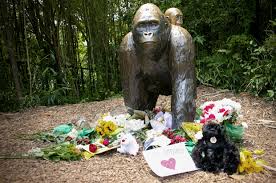
That thought crossed my mind when the little boy fell into the gorilla enclosure at the Cincinnati Zoo.  Many people accused the mother of being neglectful or unfit.  But I remember too well what it was like trying to keep track of our three children under the age of four. Although I would jokingly say that their guardian angels worked overtime, there were many close calls and many occasions when events could have turned tragic.

There was the time at Sesame Place, a wonderful theme park outside of Philadelphia. One moment we were enjoying the antics of Elmo; in the next breath, my 3-year-old daughter disappeared. I frantically looked between the legs of strangers, under bushes, and behind rides.  She was nowhere to be found. We ran to the “Lost Child” center and there she was – grinning and laughing at the sight of her mother escalating from fear to anger to joy in a second’s time. Kids move fast. They slip away. They don’t think about consequences. When I heard about the boy at the zoo, I thought – that could have been me.

Or the toddler who was attacked by the alligator at Disney World.  Would I have known that “no swimming” meant not even wading up to a toddler’s knees? Would I have realized that danger lurked at the “happiest place on earth?” Would I have resisted a squirmy, perhaps fussy two-year-old on a hot, humid night or would I have said, “yes, let’s cool off our toes in this lovely lake?”  That could have been me.

Could me 2

I am that mother

  • Who put a Band-Aid on her daughter’s elbow, not realizing that her arm was broken.
  • Who allowed her son to careen down a hill on his bike, not imagining that he would plow down his siblings like a bowling ball barreling down the alley.
  • Who didn’t listen to her son the 15th time he reported seeing a bear while camping at a national park. “Just go and play so I can get supper together,” was my reply when, just like Peter and the Wolf, that time would lead to an almost too-close encounter.

Or what about my own antics from my distant youth?

  • Sleeping on a roof top in Athens, Greece?
  • Selling my blood in Italy to earn money for an unplanned boat ride?
  • Accepting a ride from a stranger to chase after friends on a late night in a strange place?

Those incidents (and many more) could have ended badly. There could have been a news story detailing an accident or abduction or assault. That could have been me.

We are so quick to judge when we hear tragic news stories.  Instead of jumping on the condemnation express, perhaps we could listen with grace-filled ears and then wonder – could that have been me? Haven’t there been times when it was only sheer luck and not superior knowledge or skill that kept me safe that day?

It’s more than just placing ourselves in another’s shoes. It’s realizing that on this very human journey, we make mistakes. Events occur that we didn’t plan or anticipate. Accidents happen. Our judgment is not always flawless. And in a moment, lives can change forever.

It could have been me.  This time, it wasn’t. So let me hold in prayer those who are suffering today.

candle


Can we talk?

The banner hanging on the “welcome shack” at the entrance of our state church summer camp, Silver Lake, stated “Black Lives Matter.” During a weekend when several different groups were holding events at the camp, someone took a marker to the banner and wrote “All Lives Matter.”

Which is right?  Does saying that “Black lives matter” negate other lives or somehow make other lives less valuable?

Our Conference Minister, the Rev. Kent Siladi, wrote a compassionate letter  addressed to all Christians in the Connecticut Conference. He stated, “We have had spirited arguments with friends and colleagues who fervently believe that “All” lives matter, and that to single out some lives seems to diminish the worthiness of others. We disagree with that analysis, although we welcome the conversation about this.”

The conversation is not easy. After the camp banner was defaced, someone asked me, “Why is this wrong?  Don’t all lives matter?  Isn’t that what the banner should say – that God loves all of us?”

Asking questions may be the first part of this important conversation.  But then we need to be prepared to listen to a variety of opinions.  Are we willing to take that risk? Can we engage in conversation with each other?  Can we really listen to one another?

My answer to those questions would be – Of course God loves all people and all lives. Our congregation celebrates that in worship every Sunday when I announce the Good News that “God loved the world – and every single person in it so much – that God gave his only Son, Jesus.”

If we had enough banners, we could list all the people who matter – that would be everyone. But sometimes it is necessary to lift up individual stories and listen to the particular accounts of people who have suffered along the journey toward equality and justice. “All Lives” can learn from these sometimes hidden histories of pain and struggle. In order to engage in conversation, we need to be attentive to voices that are too often silenced.  We need to listen to Blacks, women, immigrants, Native Americans, Jews, lesbians, gays, and transgender – anyone who has experienced life on the margins of society. Each story is precious and can’t be contained under the sweeping label of “all.” These individual experiences need to be heard.

In a perfect world, it wouldn’t be necessary to emphasize that Black lives matter – it would be obvious. In a perfect world, every race, color, gender, and culture would be honored and treated equally. But this isn’t a perfect world.

The banner at the camp welcome shack was an attempt to announce to everyone – but perhaps especially to people of color – that in this place, we will be intentional about our hospitality. In this place we will endeavor to do what too often is not done – we will treat everyone with the respect they deserve as a beloved child of God. It’s important to say it out loud – to put up a banner announcing it – because throughout history that respect has not always been given. That continues to be the case too often even today.

It’s too easy to say, “All lives matter.” Instead, we are invited to lift up those lives that have been excluded, hurt, and dismissed. We need to have this conversation – over and over again.

Black Lives button

What aquacise teaches me about church

Sometimes I learn about faith and the church in the oddest places.  Several times each week I attend a water aerobics, or aquacise, class.  I have always loved swimming so this form of exercise never feels like “I have to” but instead like “I get to” work out.

Lately as I engage in “deep water runs” or endless rounds of “water crunches, it occurs to me that my fellow classmates form a community much like the best aspects of a congregation.

There is great diversity in the aquacize participants. We come to class, all of us – the lame and that biblical description, the “halt” (defined in my dictionary as “one who limps”), the old and the young, men and women of every size and description.  Some people walk briskly from the locker room to the pool; for others, it is more challenging.

  • One woman rolls to the water’s edge in a wheelchair, her bright pink hair and cheery smile drawing attention away from her legs that struggle to support her and which barely move enough to allow her to get to the stairs into the water.
  • There is a man who calls himself “One-legged Dave,” who arrives promptly each morning. “I lost the leg below the knee to cancer, but that’s all that sucker got – the rest of me is still here!” He sits on a bench to remove his prosthetic leg with the molded plastic foot and replaces it with a rubber flipper. “I’ll be the fastest one in class – the only problem is, I’ll go in circles!”
  • An older woman wears thick black gloves in the water. I thought this was very odd until someone explained that she had been in a serious car accident. She was severely burned, leaving her skin sensitive to the pool chemicals.

I am in awe of the courage on display here. It would be easier for each one of them to stay home. They choose to come because they find something there that nourishes their spirits. I hope the same can be said for the church.

When this unlikely collection of people is brought together on land, one can hardly imagine that they could ever comprise an exercise group.  But then – they enter the water.

In that moment, they are transformed. All the differences and physical challenges disappear in the water.  Water, it turns out, is a great equalizer.  Suddenly everyone is the same height; all we can see of one another is our heads bobbing out of the water.  Creaky knees relax as they are lifted by the forgiving buoyancy, aching muscles ease as they are massaged by the gentle warmth that surrounds us.  People who can barely walk on land suddenly experience the freedom of graceful movement in the water.

The pool provides a release that we share with joy.  In my mind’s eye, I imagine the Holy Spirit moving in and through our class, anointing each of these individuals and binding us together as a group.

I hope people experience that kind of delight when they come to church. I hope the sanctuary is a place where all kinds of people can come together and experience renewed hope and welcome. People who are weighed down by challenges in life and those who are confronted with numerous limitations in other venues can hear the Good News – you belong here. The problems that we carry with us may not be forgotten but they will not be allowed to define us.

The pool –and the church – can be a place of encouragement where members are invited to stretch their wings and find a new definition for themselves.

Everyone, of course, has a story to tell and a reason why they show up for an 8:15 a.m. aquacise class. Some people arrive yearning for some serious exercise and look forward to the workout. Others clearly come primarily for fellowship, barely pausing in their conversations to listen to our enthusiastic instructor, who guides and encourages us with great patience and creativity.

People come to worship for lots of different reasons, as well. I hope the church makes them feel as welcome as the pool does. Church can be – should be – that place where all of God’s people are on equal footing, where all of us are enveloped by the loving grace of God’s Holy Spirit.  Church can be – should be – a place where we discover new possibilities, where we are told not what we can’t do, but instead are encouraged to be amazed by what God can do in and through us.

If you see me in class, you might think I am only trying to increase my core muscle strength, but in reality, I am learning again about how God teaches me about grace and welcome and the church in very surprising places.


Where do you worship?

A recent trip took me to the Festival of Homiletics in Atlanta.  This was a week-long conference that only a preacher could love – four very full days of preaching and worship, then lectures on preaching and worship, followed by evenings of – yes, more worship and preaching. But if you’re eager (as I am) to learn more about the art of “homiletics” (giving a homily or sermon), then this was the place to be.  Ministers, priests, chaplains, vicars, and prelates gathered from all over the United States and Canada to listen to luminaries in the preaching field; skilled professors, authors, and worship leaders challenged us to remember what a privilege it is to reflect on God’s Word. It was an inspiring week.

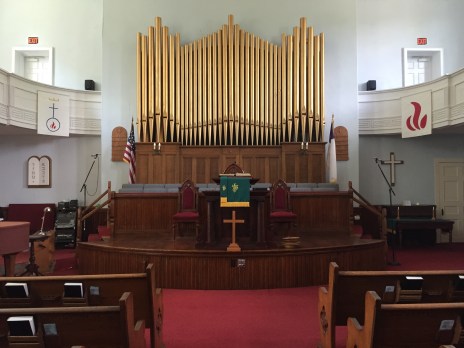
Part of the inspiration came from our surroundings. Over 1200 clergy folks easily fit into the astonishing Peachtree Road United Methodist Church. This magnificent downtown church is very different from the simple beauty of my country Congregational Church.  It is often said that entering a sanctuary should cause the worshiper to experience a feeling of humility and an awareness of the majesty of God.  With its soaring ceilings reaching up to heaven, magnificent stained-glass windows, beautiful wood carvings of descending doves, and an organ with hundreds of glistening pipes, that is accomplished at Peachtree. As the music started and all of those enthusiastic ministers lifted up their voices together in praise, it sent shivers down my spine.

So it made me wonder – where do you worship?  Where do you experience God? What sounds or sights or smells help quiet your spirit so you can listen for God’s voice? Where and when are you reminded that you are a beloved child of God?  I hope there is more than one location and more than one situation that soothes your spirit and reminds you that God is near.

EWCC sanctuary

There is pleasure in discovering God in a variety of settings. I enjoyed the splendor of this downtown mega-church and yet I was very glad to return to the clear glass and plain walls of my New England roots.  Now that the weather has (finally) turned pleasant, I increasingly find myself aware of the Creator in the midst of creation. My backyard can become worship space when I take the time to listen to the birds trilling and pause long enough to watch the clouds floating by on the breeze. This summer I am going to experiment with offering evening worship at a local park – “Tuesdays at Twilight” will invite people to experience God in the midst of creation.
Roseland park

Where do you worship?  We can, of course, worship anywhere – in the car, the laundry room, at the dinner table, before falling asleep. We can worship with hundreds of people, in the company of two or three or in solitude. The invitation is always there – God invites us, each one of us, into God’s presence.  It is simply a matter of saying “yes” to God – and in that moment, worship begins.

Roots and Branches

Sometimes a minister’s life is just a pleasure.  Going on and leading retreats is one of those times. Last weekend I was delighted to be with a group of women from the Kensington Congregational Church (UCC) to lead a retreat entitled “Roots and Branches.”

We stayed in the lovely Mercy Center in Madison CT.  Simply being in this lovely space looking out on the Long Island Sound was enough to relax the body and ease the spirit.

Mercy Center     Mercy Center 2

A retreat offers an invitation to slow down, step away from the computer, turn off the phone, and simply soak in the beauty of God’s creation. Jesus speaks to us with both wisdom and compassion when he says, “Let’s go off by ourselves to a quiet place and rest awhile” (Mark 6: 31). This is an invitation to immerse ourselves in Sabbath rest, something that is all too rare in our 24/7 frantically-paced society.

Those precious hours away provided us the time to consider Jesus’ description of our relationship with him. He declared, “I am the vine; you are the branches. If you remain in me and I in you, you will bear much fruit…” (John 15:5).

Roots and branches

We talked about these questions:

  • What are some of your roots?
  • Where do you come from?
  • Who were some of your early teachers?
  • How does our faith provide us with grounding and sustenance?
  • What roots do you treasure and which ones would you like to distance yourself from?

We considered the question of “healthy pruning” – how sometimes it necessary to cut ourselves off from people and situations that do not feed us or might even hinder our growth. Because we believe in the God of hope, we trust that even if one root is severed, another can develop in its place. We worship a God of new life and endless possibilities.

We discussed the experience of being uprooted. Sometimes life can change in sudden and dramatic ways, leaving us disoriented and lost. That is a time when we need to grow new roots and trust in our ability to begin again.

On the other hand, there are times when we choose to uproot or transplant ourselves – we might need a healthier environment in which to grow and a place where our spirits can be fed and nurtured. Sometimes it can be vital to leave the past behind and seek out a more nurturing environment.

Once we considered our roots, our group talked about our branches – those growing edges, those places and dreams in us that still need to grow. Just as many plants and trees experience a time of dormancy and rest, so also do we. This quiet stage of life does not mean that we have ceased to grow, but only that the potential is building and will yet be realized.

We mulled over these questions:

  • What are some of my hopes and dreams?
  • What new experiences would I like to have?
  • Where might God be inviting me to grow and change?

There are endless examples of plants and trees growing in unlikely and even seemingly impossible places. We can yearn for that same desire to flourish even when the odds seem stacked against us.

Flower growing through concrete

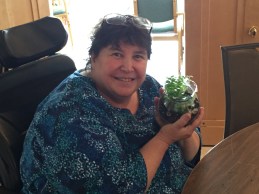
As a reminder of our time together, we created terrariums. These small vases contained beautiful plants as well as shells, stones, and driftwood collected from the beach.

Terrarium 2    Terrarium 3

Terrarium 4    Terrarium 5

Reluctantly we left that beautiful space – we cannot live on retreat. We are called to go back to our lives and our responsibilities. But we hope that the experience of soaking in the wonder of a “quiet place” will replenish our spirits so we can share God’s love and light wherever it is that are called to live and grow.


Radical Hospitality

On May 2nd, I led a workshop about “radical hospitality” at Hartford Seminary.  Here are some quotes and images that I shared to emphasize my belief that God loves and welcomes everyone.

You’ve heard me say it before and here it is again: each one of us is known and named by God. The name God gives us is “beloved.” Because we are God’s beloved, we are always welcome in God’s sight to receive God’s gifts of love, forgiveness, new life and hope.

The question for faith communities is – how do we intentionally share, demonstrate, and announce that welcome?  That’s where hospitality comes in.

Henri Nouwen says, “Hospitality means primarily the creation of free space where the stranger can enter and become a friend instead of an enemy.   Hospitality is not to change people, but to offer them space where change can take place.”  (Reaching Out)

Hospitality and welcome are intentional acts.  People will rarely just “happen” to come t our places of worship.  We must provide an inviting website, an engaging Facebook page, and be proactive about creating a welcoming atmospher in our buildings. A book that offers very helpful insights = Side Door: How to Open Your Church to Reach More People by Charles Arn

Do our buildings reflect our welcome?  If someone walks into your church, what do they see?  Are there signs and symbols that reflect your eagerness to meet them?

Here is a sign that is on the door of my office:

Jesus didnt reject rainbow fish

And – how do we reach beyond our doors?  How do we go out and meet God’s people where they work, play, meet, and relax?

safe space for everyone


Here are some quotes that remind me of the importance of hospitality:

“If we could look into each other’s hearts and understand the unique challenges each of us faces, I think we would treat each other much more gently, with more love, patience, tolerance, and care.”      (Marvin J. Ashton

“Do not despise those faithful who come to you seeking hospitality. Receive them, put them up, and set them on their way with kindness, treating them as one of yourselves.”     (St. Cuthbert)

Welcome sign

“Not all wounds are so obvious. Walk gently in the lives of others.”    (unknown)

“Always leave people better than when you found them. Hug the hurt. Kiss the broken. Befriend the lost. Love the lonely.”   (unknown)

“In order to unite with one another we must love one another;  in order to love one another, we must know one another; in order to know one another, we must go and meet one another.”   (From the testament of Cardinal Mercier, Archbishop of Malines- Brussels, 1926.  Growing Hope by Neil Paynter)

Hospitality angels


Passages

For a thousand years in your sight are like yesterday when it is past, or like a watch in the nightThe days of our lives …are soon gone, and we fly away.”   Psalm 90:4, 10

Permit me to reminisce for a few moments.   In March 1993 there was an enormous, airport-closing blizzard which delayed our much-anticipated trip to Bolivia to pick up our infant son Daniel. After many delays, frantic phone calls, and fervent prayers, Roger and I landed in warm, sunny Cochabamba and embarked on a life-changing journey.  The details are still fresh in my mind and in many ways it seems like it was just yesterday; it is hard to believe that our beloved son will graduate from college on May 17th.

These are the markers of our lives – birth, death, baptism, wedding, birthdays, graduations – all those special occasions remind us of the passage of time and the preciousness of life, love, and relationships. This congregation has been part of our journey.  Before we departed for Bolivia there was a marvelous baby shower for us in fellowship hall.  When we returned, many of you met Dan even before his grandparents did.  He was baptized here. When I was a nervous young mother, he would be quietly passed from one set of loving arms to another while I led worship, preached, and chatted during coffee hour. It was a gift to know that he was well cared for by his church family.  We have pictures of him in the Christmas pageant (making the requisite transition over the years from sheep to shepherd to King Herod), riding his decorated bike at the Jamboree, singing in his blue RSCM robe, dressed up in a tie and jacket for confirmation, and singing with the men’s chorus on Palm Sunday.

Passages. Days, weeks, months, and even years slipping away. Children growing up and adults growing older. All of us are left shaking our heads and wondering, “Where has the time gone?”

Time does fly by and we seem in a hurry to try to catch it. I heard a wonderful sermon once entitled “Worshiping a 3 MPH God in a 100 MPH world.”  We live in a 24/7 society where we can be busy every moment if we choose to be. The pace can be so frantic that we may not even notice the people around us or the God who weaves in and through our lives. In a blink of an eye, it seems, years can go by.

We are the only ones who can decide to make changes in our own lives – we can choose to stop, or at least slow down.  How will we spend our precious time?  Who do we want to spend time with?  What dear friends are you always too busy to visit? What activities really matter?  Which ones will make a difference? When was the last time you noticed the beauty of the place that we all live – and when did you pause to give thanks for that blessing?

Here is an invitation to be aware of the passages that are part of all of our lives. Can we intentionally decide to cherish the moments of our lives and to give thanks for the people who enrich our days?  Take a moment right now and give thanks for some special person in your life.  And then take another moment to let them know just how much they matter.

Blessings on your journey through the many passages of life.

Graduation

Searching for resurrection

Now that Easter is over, where should we look for resurrection?

On Easter Sunday, new life was everywhere – it was so easy to see.  Our 6: 30 a.m. sunrise service was cloudy and we didn’t actually see the sun rise, but there was a hearty group of people gathered to sing in the new day. It was a good celebration.

Later on that morning, our sanctuary was filled to overflowing as people squeezed into the pews and lined the back wall. The purple drape on the Cross was replaced with fresh flowers. Easter lilies crowded the window sills. The pulpit was surrounded by tulips and daffodils. Our plain, simple, somewhat stark Congregational meeting house was suddenly blooming with color. And then there was that wonderful moment when hundreds of people lifted up their voices to sing, “Christ the Lord is risen today!”  Our shouts of “alleluia!” bounced off the walls.  There was no doubt – even a newcomer or a stranger walking in off the street would have known – this was a day of celebration.

But what about now?  The crowds went home. A freak storm erased every sign of spring as the daffodils and crocuses were buried under wet, heavy snow. My phone started ringing early on the Sunday after Easter. “Is church cancelled today? Should we try to come in through all this snow?”

Just a week after Easter, signs of resurrection were hard to come by. Worship attendance was sparse on that Sunday after Easter. The leftover flowers looked a little worse for wear. The volume of the hymns – still songs of resurrection during this Easter season – were notably quieter.

Sometimes it’s easy to see Easter.

Sometimes – not so much.

Sometimes there are visible, obvious signs of new life.

Sometimes we have to really search to find some Good News to celebrate.

Where do you see signs of resurrection these days?  How do you discover the hope of Easter?

The disciples had the same challenge 2000 years ago.

Mary stared the risen Christ in the face and still didn’t see the hope standing in front of her. Resurrection was unrecognizable in the middle of death, surrounded by grave sites, and steeped in silence.

It’s so easy to believe in failure. We can be overwhelmed by death and desolation, violence and defeat.

Resurrection, though, is trickier.  It’s often subtle; we have to search it out.  It was wise Mr. Rogers who famously said, “Whenever there is a tragedy, look for the helpers.” That is where we will see God. After the bomb blast, in the midst of a storm, during a crisis – look for those who are rushing in to help.  That’s resurrection. There is hope even in the midst of despair.

The Good News was announced at the tomb, “He is not here, he is risen.” The women ran to tell the others.  And that is how rebirth and new life is shared.

Where will we recognize God at work?  And how will we spread that Good News?

Daffodil in snow2

A Tale of Two Trees

A Tale of Two Trees

We want life to make sense. Sometimes it doesn’t. Let me tell you a tale of two trees.

There was a tree growing by the side of the bucolic Merritt Parkway in CT. The trunk suddenly cracked, causing the tree to fall across the road, crushing a car and killing the parents of two young children who were sitting in the back seat. In an instant, lives were ended and a family was destroyed.

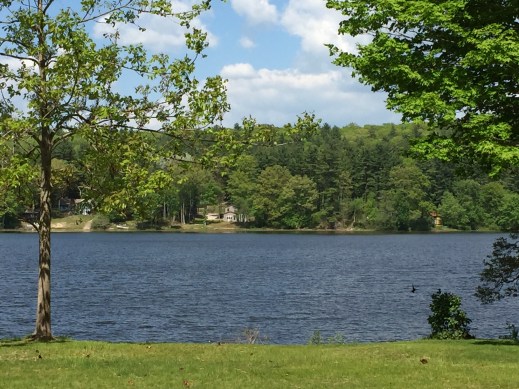
There was a tree by a lake. My sister-in-law and her best friend sat in the lovely shade, enjoying the breeze, looking out at the water, and sharing conversation. They got up and went inside the house. Fifteen minutes later an enormous limb plummeted to the ground, destroying the now unoccupied chairs. Had they still been there, they certainly would have been killed.

Why do things like that happen?  Why was there one tragedy and one miraculous escape? It is very human to yearn for some reasonable explanation. The guardians of the suddenly orphaned boys sued the state of CT, declaring that the transportation department should have anticipated the tragedy and protected the travelers on that beautiful tree-lined highway.

That’s what we crave – some sort of guarantee that someone will be watching out for us and always keeping us safe. We want this formula to work – if we do everything just right, follow the rules, and mind our own business, our lives will follow a neat, predictable path.

The problem is – life isn’t that neat and tidy. Bad things happen in our imperfect world, often without any good reason. As much as I love my sister-in-law, I don’t believe she is a better person or somehow more deserving than the parents of these young children.  Sometimes people are in the wrong place at the wrong time through no fault of their own.  Just ask families mourning in Belgium, Afghanistan or India.

Sometimes people cause bad things to happen. Sometimes bad things just happen.   God does not guarantee a safe passage through life. Instead, God promises presence – the assurance that in green pastures as well as in dark valleys, God will offer strength, guidance, and compassion.

Life can be frightening. We can make it better by reminding people we don’t have to go through it alone.

Two trees 3