Preparing to give thanks

 This reflection was published in the devotional magazine These Days.  I wanted to share it with you as we prepare for Thanksgiving.

“So now I bring the first of the fruit of the ground that you, O Lord, have given me.” Deuteronomy 26:10

The ancient Israelites brought their offerings to God, collecting the “first fruits,” the very best of their crops to present to the Creator. They expressed their thanks for the harvest, whether it was bountiful or slim, knowing that all they received came from God.

How do we express our thanks? The Bible repeatedly invites us – commands us –  to praise the Lord, give thanks to God, and come into God’s presence with singing.  Being grateful is not passive, it is active.  First we need to notice our blessings. Then we respond by giving thanks.

How will we express our gratitude today?  Who do you know who might need to be thanked today? Whose work is overlooked or undervalued? Who could benefit from receiving appreciation? Saying “thank you” could change their day – and yours.

Action Step: Consider creative, tangible ways you can express your gratitude to God. Who will you thank today?

Generous God, help us recognize the blessings you place in our lives. Amen.

Even in this circumstance, give thanks

Enter God’s gates with thanksgiving, and God’s courts with praise. Give thanks to God, bless God’s name.   Psalm 100

“Come you thankful people come,” we sing annually on Thanksgiving Sunday as we gaze at the cornucopia lovingly crafted by our favorite 90-something year old member. Overflowing with fruits and vegetables native to New England, she reminds us this horn-shaped symbol of plenty is “A living symbol of God’ abundant blessings.”

“Enter God’s gates with thanksgiving,” the Psalmist directs us. Admittedly, it is easier to approach those heavenly courts with praise when the sun is shining and all is right in our world.  But what about the other times?

Paul can sound like a grating nag when he urges, “Give thanks in all circumstances,” (1 Thessalonians 5:13). How would you like us to do that, Paul, when our spirits are nearly broken by circumstances that weigh down our souls?

Corrie ten Boon’s memory of leading forbidden worship in a World War II concentration camp might shed some light for us. Almost crushed by the effort of offering praise amidst wretched, flea-infested, frigid surroundings, they worshiped God.  Always fearful of discovery and punishment, they lifted whispered prayers of thanksgiving not only for the beloved community in that unholy place but also for the hardships they helped each other bear.  Months passed as their cherished worship continued uninterrupted by the usually brutal guards, offering encouragement to their battered spirits. Decades later, Corrie encountered a former prison guard who admitted he had never ventured into her barrack because he feared the overwhelming flea infestation. God was indeed in that place, utilizing every means to bless those worshipers.

We give thanks in all circumstances, not for them. Giving thanks for every good thing is easy. Giving thanks while staring down hatred, injustice, poverty or sadness may strain our faithfulness. Discerning God’s love while receiving cancer treatments, caring for a critically ill loved one or agonizing over a wayward child may challenge our belief.

Giving thanks is the beginning of trust. When we dare to pray, “Thank you God for being with me in this circumstance,” we may discover God’s strength and blessing when we need it most.

And may we pray, “Faithful God, may we remember the words of Meister Eckhart: If the only prayer I pray is ‘thank you,’ it will be enough. Thank you. Amen.”

After Election Day

Commentators counting down the hours to Election Day make it sound like the doomsday clock is ticking away. One could think the world will end on November 8th.

It won’t.

On November 9th some things will be different. We will have a President-elect.

But – reassuringly – many things will remain the same.

  • The God of yesterday, today, and tomorrow will be with us. God’s faithfulness will continue to endure forever.
  • God’s love, forgiveness, and mercy will still be bigger than any political process.
  • God’s truth abides. This remains true even after centuries of war, famine, poverty, hatred, and evil working to silence voices of hope and compassion. It will be true even after this nasty election season.
  • We will still be welcomed into God’s presence – every single one of us.

The needs of the world – globally and in our back yards – will remain. Jesus said the poor will always be with us. We will need to remember

  • The hungry and the homeless
  • The lonely and the broken-hearted
  • The food insecure
  • Those who are poor in hope or strength, those who need a helping hand or a kind word.

We will still be called to love our neighbors.  All of them.

We will still be called to love our enemies.  All of them.

No matter who wins the election, I pledge to pray for that person.

  • I pray that person will be surrounded by prudent and balanced counsel.
  • I pray that person will have wisdom to accept the vast responsibility of leadership with humility and grace.

No matter who wins on November 8th, many people will be unhappy on November 9th.  I pledge to discover ways to help us listen to one another.

  • We will need to ask one another questions and promise to pay attention to the answers.
  • I hope we can try to imagine what another person’s journey is like.

Deep divisions, mistrust, fear, and anger are with us now. They will remain after November 8th.

But on November 9th – and always – God will be with us, calling us to “bring good news to the oppressed, bind up the brokenhearted, proclaim liberty to the captives, and to comfort all who mourn” (Isaiah 61).

The world won’t disappear, but the world will need our help.  Let’s focus on that.

Good Samaritans I have known

Jesus told us, “Go and do the same” as the Good Samaritan.  Go and

  • Be that caring.
  • Recognize the need right in front of you.
  • Be willing to reach out to someone who is different than you.
  • Break down the barriers and go the extra mile.
  • Dare to speak up.

That’s what it means to love God and our neighbor. How do we do that?

Maybe we can be inspired by Good Samaritans we have encountered in our lives.  Have you met one?  I know I have.

  • The stranger who paid for my coffee in the drive-through lane.
  • The kind lady who allowed me to go ahead of her in line at the grocery store.
  • The thoughtful person who left scones at church for me and my secretary, with a note, “You are appreciated!” It made our day.

There was the family who gave me a ride to a distant city when I was in college. When I missed the bus to my summer job, they brought me to their home, fed me supper, let me stay overnight, and then delivered me to the correct bus in the morning.  I don’t remember their names, but I cherish the memory of their kindness and hospitality.

Good Samaritans are all around us, if we look.  I see them in

  • The volunteers who cook for our community kitchen each week.
  • The man who brings the newspaper in every day for his homebound neighbor.
  • The child who draws a picture to cheer up a sick friend.
  • The knitters who create prayer shawls.
  • The young mother who breastfeeds an abandoned baby in foster care so he’ll have a healthy start on life.

None of those actions change the world.  Neither did the Good Samaritan; he simply helped one wounded stranger by the roadside. But the story of his compassion is being told 2000 years later because he made a difference.

There’s much we can’t do.  That shouldn’t stop us from doing what we can. We need to share kindness. We need to love our neighbor. We need to go past our comfort zone and reach out to others. We need to recognize that stranger as another one of God’s beloved children.

We need to go and do the same.

Gross encounters of the unwanted kind

A woman in her 80’s stopped by my office this week to reflect on a time she had been sexually harassed by a college classmate. Although the event occurred decades earlier, she still hesitates to attend school reunions, fearful to encounter him again.  “Just seeing him makes me feel sick to my stomach,” she said, “Do you know what I mean?”

I do indeed.  I would be willing to bet that every woman understands. If we gathered a group of woman together, each one would have at least one story of a time when she was harassed, molested, assaulted or spoken to in a way that made her feel disrespected or dirty or ashamed. Or just plain angry.

It’s been all over the news lately. The politics of the situation are not as important as the need to have this conversation, to get the problem out in the open.  Our sons and our daughters must listen so they learn to treat one another with respect.

We can start by sharing our stories. The “gross encounters” that I have experienced are probably no worse than anyone else’s.  I could tell you about the time when

  • Two boys were playing a rough game of tag with me at a school picnic when I was eleven. Suddenly one of them grabbed me and pushed me to the ground, pinning my arms down while the other boy reached under my shirt.  I can still hear their breathless laughter. That ended when a male teacher yelled, “What are you kids doing?” He then went on to childe me about teasing boys.
  • I was on my junior year abroad from college, backpacking with a male companion by train through Europe. He behaved like a gentleman for our entire trip, living up to our agreement to travel as friends, despite sharing rooms and living in close quarters. But on a night train to Rome as I ventured down the corridor to the bathroom, a stranger lunged out of a compartment, pushed me against the wall, and tried to kiss me as his hands groped my body. It was only when I brought my knee up suddenly that he stopped and pushed me away.
  • I received an envelope in the mail filled with images of violent pornography after challenging my male college dorm mates about the volume of their music. “Women should be quiet” was the only repeatable phrase scrawled across the vile photos. I could never prove that it was them, but I always felt afraid when I walked by their room.

Many women have experienced much worse.  Many women live in fear every day.

Every Sunday I announce God’s grace and forgiveness by announcing, “You are cherished by God.”  I want everyone in my congregation to know they are created in God’s image and deserve to be treated with respect.  Gender, race, sexual orientation – none of that matters. The person you see in the mirror – that person is God’s beloved.

Imagine how different the world would be if we treated one another that way.

Beyond our borders

What happens when we only want to be with “our kind”?  I shudder when I see this poster advertising a Klan rally in my idyllic, peaceful town.  The poster clearly defines who was being addressed –  all “White, Gentile, Protestants” were invited.  That leaves a long list of folks who were not welcome at this gathering. This group of people who only wanted to meet with “their kind.”

kkk-rally-woodstock

1926 was a long time ago.  I have never seen a poster overtly encouraging segregation or advertising hatred. But you don’t have to look too far on Facebook or other social media to discover hate-filled messages and hurtful words.  There are many ways to communicate who is welcome in “our” circle and who is not.

This month our church is studying stories from Genesis. The Tower of Babel is described as a monument to self-preservation. God had told new his creation to go out, scatter far and wide, be fruitful and multiply.  And what did they do?  They “settled down.”  They stayed in one place. Instead of adapting a spirit of adventure and a curiosity to discover God’s diverse creation, the people hunkered down.

It turns out that being sedentary is not only bad for our health, it is bad for our spirits. Instead of expanding their horizons, the people stuck close to home with others who looked like them and talked like them. They didn’t want to be explore. They resisted change. They feared what (and who) might be “out there.” They celebrated their safety by building an enormous city complete with a tower symbolizing their self-absorbed complacency.

God put an end to all that.  God broke down the city walls and destroyed their tower.  The people were sent out to confront the challenges of different languages, races, and cultures. God’s people had to fulfill their destiny to “scatter throughout the earth.”

That ancient story comes to mind as I listen to candidates urging us to build a wall to protect our multi-cultural, complex, interracial nation. This story haunts me when I find myself avoiding people with opinions, lifestyles, and and customs different from my own. We are not called to a life of relaxed self-satisfaction. We are invited (and sometimes even not too gently nudged) beyond our comfort zones to places of encounter and learning and exploration.

All of God’s people are our kind of people. We become more complete not when we limit our interactions but instead when we dare to listen to and learn from each other.


Why suffering?

The hospice volunteers wanted to hear my “biblical perspective” on suffering and pain. These compassionate caregivers, who spent hours each week with critically ill patients, were taking some time to wrestle with questions repeatedly posed to them.

“They want to know why this is happening.”

“She asked if God is mad at her.”

“He wants to know what he did that was so wrong to make him so sick.”

“Why is God doing this?”

As a local pastor I was invited to provide insight and maybe encouragement to these every-day angels who are on the front lines, bravely going into people’s homes to offer care and a listening ear. It’s hard work, that kind of caring. The patients tormented these well-meaning Nightingales with bewildered and sometimes angry questions. What could they possible say in reply?

What, indeed? If life were fair, only bad people would experience illness while the good ones would somehow be rewarded.  That certainly doesn’t seem to happen. How do we respond to arbitrary suffering when we often want to shake up fist at the universe or shrug our shoulders in despair?

What would you say?

I didn’t fool myself into thinking I could provide any “answers.” The mystery of grief and illness has tormented humankind ever since the Garden of Eden. But that gave me an inspiration.

“Let’s look at Genesis, chapter 1,” I suggested.  You’ve heard the story – in the beginning, God created the heavens and the earth.

When God lovingly, carefully, deliberately crafted humankind , God looked at those fragile, marvelous creatures, made in the image of God. “Very good,” God said.

Right from the beginning, there was a special relationship there.  God chose us, right from the start. When God looks at us, God sees

  • Someone very good.
  • Someone who is loved and lovable.
  • Someone filled with God’s Spirit.
  • Someone who is created and creative, filled with endless possibilities.

I don’t know why bad things happen to anyone.  But I do know this – God doesn’t send sickness or earthquakes or Zika viruses or droughts or car crashes to punish people.

Sometimes we harm ourselves.

Sometimes stuff just happens.

What God does promise is to be there when we need God most.  Sometimes God shows up looking just like a hospice volunteer, ready to hold a hand, wipe a tear, and with a reminder that we are precious in God’s sight.


Responding in a moment’s notice

The deer appeared out of nowhere. The driver two cars ahead of me slammed on her brakes but not before the deer skidded across her hood, swung up and over the roof of her car, and crashed down on the road, where it limped into the woods. And just like that, life had changed and the day was not the one that she had been expecting.

The car in front of me car stopped and the driver jumped out, ready to help and share her concern.  I wish I could say I responded with such enthusiasm.

As two pick-up trucks roared by, eager to continue barreling down the country road, I considered my options. I have to admit I hesitated. I could see no one was hurt.  A Good Samaritan was already on the scene to provide assistance. And honestly, I wanted to get home, tired after a long day of meetings, and yearning for a cup of tea before the evening’s activities unfolded.

A bit grudgingly, I pulled over.

And I’m glad I did. The driver who hit the deer was understandably shaken up.  Neither she nor the woman who had stopped were familiar with the area, so I was able to offer ideas about how to get help and describe just which corner of the woods was our current location.

Surprisingly (for our remote area), a kind, efficient and reassuring police officer arrived to offer assistance.  After a quick hug followed by well wishes, I was on my way.

But the incident left me wondering:

  • What if I went through life with this attitude – where can I help?
  • What difference, large or small, can I make?
  • Who might need a helping hand or reassuring word today?
  • What simple act of kindness might touch someone’s life?

We don’t always get to prepare our response. We don’t get to rehearse our attitudes. All of a sudden someone may need our help.  How will we respond?

Often it turns out that no special tools or skills are necessary.  Just showing up – just being there – we can make all the difference.

Henri Nouwen’s wisdom offers words to live by:

“Did I offer peace today?
Did I bring a smile to someone’s face?
Did I say words of healing?
Did I let go of my anger and resentment?
Did I forgive?
Did I love?
These are the real questions.
I must trust that the little bit of love that I sow now
will bear many fruits, here in this world and the life to come.”

helpings hands2

The opportunity to share compassion may come without warning – and we are asked to respond in a moment’s notice.


Myths of Motherhood

“Cherish these moments,” cooing grandparents would tell me as they watched me tending my small tribe of children.  “These days will fly by.”

I hated that expression.  Inevitably, those words made me feel like a bad mother. Too often, they were simply not true. With three children under the age of four, many days did not “fly by.” Instead, there was often a seemingly endless parade of dirty diapers, spilled drinks, broken toys, missed naps, overflowing toilets or bathtubs, cranky children and even crankier mother.

These well-meaning adults, far removed from their own parenting moments, were passing along some myths of motherhood.  Idealized versions of parenthood are conjured up in commercials, greeting cards, Facebook and Pinterest. There are endless examples of smiling mothers and children enjoying tranquil moments of blissful calm as they share arts and crafts, tend exquisite gardens or create healthy meals. My reality never seemed to measure up. I often felt like I was falling short in the mothering department.

There was the day when my 3 year-old, 2 year-old, and infant all woke up well before sunrise, full of energy and ready to be entertained.  I struggled to rise to the occasion by reading books, offering craft ideas, and going for a walk (in itself, a feat that required ingenuity and stamina as I pushed the double stroller with the baby on my back).  Finally, I decided I would offer an early lunch so we could move on to naptime and a well-deserved rest for everyone.  Imagine my dismay when I looked at the clock.  It was 9:00 a.m.

No, days like that did not “fly by.”

Of course there are many precious memories. Those sweet moments of bedtime stories, snuggled together and delighting in escapades from far-away lands. The adventures of not one, not two, but three cross-country camping trips when we marveled at the beauty of changing landscapes and delighted at experiencing bison, mountain streams, and starry nights. Day-to-day family life, sharing laughter and games with friends and neighbors.

“Watch out!” people would warn us, “Before you know it, they will be grown up and gone.” But that isn’t the whole story. We do young parents a disservice, I believe, when we offer only the “Disney” version of parenting. Being a mother is the hardest and best thing I have ever done. A lot of time I was simply tired despite being blessed with my dedicated, hands-on, fully involved husband.

Instead of telling young parents that these moments will “fly by,” let’s share the wisdom an experienced mother told me.  “The days can be long,” she said, “but the years are short.”

Now our nest is officially empty; the era of all five of us living under one roof, regularly sharing meals and dividing chores is over. I am filled with gratitude for literally millions of cherished memories.

But I don’t want to forget the hard days. It took time, effort, and dedication to get to the point where our children could venture out independently.  Even now, we assure them that our nest has a revolving door; they can come home to re-group and re-establish themselves any time.

I am determined not to pass along myths about motherhood.  Instead, I want to offer new parents support, encouragement, and understanding as I acknowledge that many days will be far from perfect.  We don’t need the myths – the truth is more satisfying.

Long days, short years.   And blessings to last a lifetime.
drj-2

Holy Moments in a Secular Celebration

“Why does your church host a Fourth of July celebration?” I was asked in the midst of the joyous din that is our Fourth of July Jamboree. “Don’t you believe in the separation of church and state?”

I believe in it and give thanks for it daily. Our faith and beliefs cannot be dictated by any government. Our religious practices cannot be defined by outside forces. Separation can be a good thing. We are grateful for our country that allows us those freedoms. The Fourth of July offers the opportunity to give thanks for the land of the free and the home of the brave.

Life can rarely be neatly separated into “holy” and “secular” moments. God is bigger than particular dates on a calendar. If we have eyes to see and ears to hear, we can become aware of the holy, even adorned in red, white, and blue.

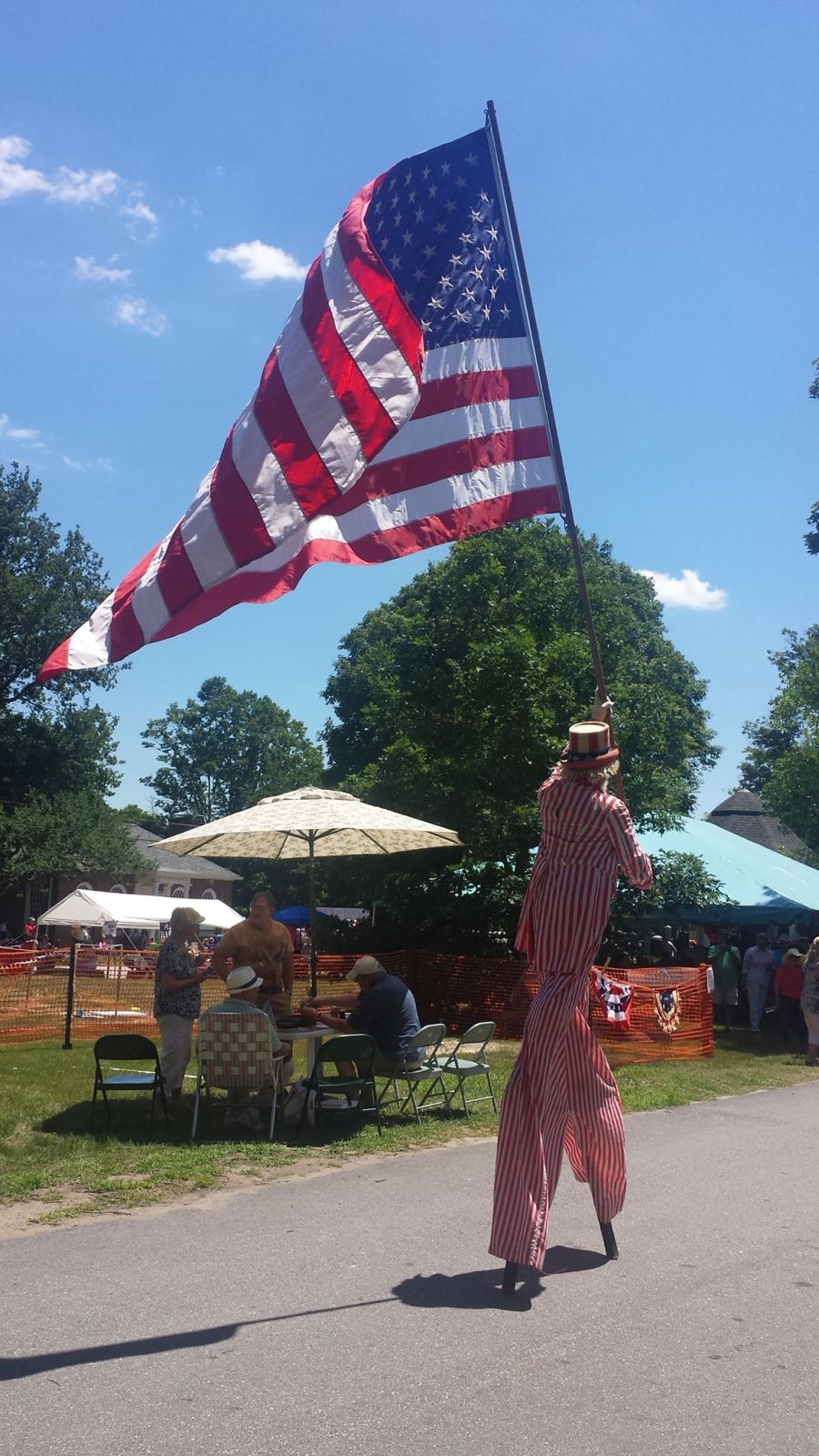
During our Fourth of July Jamboree, there were games for children, a parade, the firemen’s water polo, chicken barbeque, hay rides, and an eclectic mix of music from our bandstand. The day was quintessentially Norman Rockwell, an old-fashioned celebration that brought people together.

Yes, the Fourth of July is a secular celebration. Yet in the midst of it, I witnessed some holy moments.

  • Hush. There was a blessed quietness that spread through the crowd as we prepared to sing the National Anthem reminded me of a sacred moment of worship. For just a moment, there was a lull in the chaotic cacophony of crying babies, exuberant children, and enthusiastic adults as together we paused to lift up our voices together.
  • Respite. People took a break from their busy lives. The psalmist urges us to “be still” in order to experience God’s presence. “Still” is not the word that comes to mind while the Cornet Band plays and hundreds of people mill about the common. But the pace was slower. People went on hay rides, enjoying the beauty of farm fields with corn and cows.  Families relaxed with picnics as they listened to the music.
  • Jamboree 4
  • Fellowship. People took the time to talk and laugh while meeting old friends. One of the ironies of our modern media age is the experience of increased isolation.  We communicate with computers on a daily basis yet often long for simple, human interactions.
  • Real – not virtual – life. There was not a computer in sight. That in itself is a blessing. Children played games, colored pictures, and giggled in the bounce house while adults pitched horse shoes, and people of all ages lounged in the shade, content to gaze at puffy clouds dotting the deep blue sky.Jamboree 3
  • Encouragement. As our somewhat rag-tag parade wound around the common – twice – we cheered each other on. The parade offered an opportunity to admire beautifully restored antique cars, gratefully applaud the platoon of volunteer firefighters, and clap for children riding decorated bicycles, and little ones riding the homemade “hobby horses” they had created earlier. Wouldn’t life be better if we were always freer with our compliments and praise?
  • Community. There was at least one woman there who joined our congregation because of the Jamboree. When her husband passed away, her only experience with a church was the joy she discovered at this secular celebration on the 4th of July. She reached out in her need and discovered a congregation glad to offer support and companionship.

God can’t be regulated out of existence. On secular days, holy days, good days and bad ones, God can be found where God is needed most – with God’s people.