Celebrating our “Kindness Tree”

A tree grows in our sanctuary.  Actually, it is pretty barren right now, with a single paper leaf dangling on it.  This is our “Kindness Tree.”  During the season of Lent we will be talking with our children and congregation about how we live out Jesus’ command to “love our neighbors as ourselves.”  Each week we will add another leaf to celebrate acts of kindness. And together we will wonder – How do we live kindness?  How do we share kindness?

In the midst of the excessively nasty rhetoric in the news and social media these days, it is important for the church to offer another voice, an alternate tone, and a different viewpoint. There are few public figures that I as a parent would lift up to my children as viable, admirable role models. There are words and phrases spewed across the airwaves that we would not allow our Sunday School children to repeat. And there are attitudes and hateful opinions that contradict the Gospel of love and new life that we cherish.

What’s a church to do?

We can offer a new conversation. We can encourage our children to listen to the life-giving voice of the One who created them and loves them unconditionally. We can be inspired by Jesus who always reached out to the outcasts, shared meals with the shunned, and healed the forgotten, the lonely, and the hurting. We can try to follow his footsteps.

We can live kindness.

Every week during Lent we will listen to stories and examples of people who make a difference in someone’s life. Our role model will be the Good Samaritan who had the wisdom to recognize a beaten, abused man left on the roadside as a beloved child of God. The Samaritan was himself part of a reviled group of people; popular opinion labelled him as a subhuman who should be feared.

The Samaritan didn’t allow others to define him. He didn’t listen to their narrative and wasn’t swayed by their opinion. Instead, he lived his truth.

He shared loving kindness with a stranger.

Sometimes people talk about “giving up” something for Lent and it may be that weaning ourselves away from the endless negative chatter would be a good start. But perhaps adding something to our lives would be even more important.

  • We can speak words of kindness.
  • We can share acts of thoughtfulness.
  • We can remind one another – friends and strangers – that we are created in the image of God.
  • We can be gentle with one another.
  • We can encourage each other.
  • We can wonder if a person we encounter is going through a difficult time.
  • We can extend grace.

Every day between now and Easter, let’s make someone’s life a bit better.

As Aesop reminds us, “No act of kindness, no matter how small, is ever wasted.”

Kindness tree 1


Loving the “other”

Have you ever had the experience of being “other than” everyone else? Have you ever felt like an outsider or been excluded because of some characteristic that somehow defined you?

Even after all these years, I clearly remember how it felt to be the only 7th grader in an 8th grade gym class. Some scheduling error determined that unhappy fate for me. One might think that a year’s age difference was not insurmountable. My parents cheerfully assured me it would be a learning experience. The teacher was uninterested in my reluctance. During that very long year I endured “missing” sneakers, my (incredibly ugly, yet required) gym uniform repeatedly disappearing, cold water being poured over the shower curtain, and endless snide remarks. I was the “other” and thus, easy prey.

Years later, while working in Germany, I was searching for an apartment. In those  pre-internet days, one would write a note in response to a newspaper advertisement. If an apartment was still available, the landlord would then call. Time after time, when the apartment owner heard my accented German, the apartment suddenly became “unavailable” and the phone call ended. No one wanted to welcome an “outsider” in.

Perhaps you know what it’s like to be the “other” because of your

  • gender
  • skin color
  • nationality
  • sexual orientation
  • age
  • beliefs or political opinions

We humans are too ready to divide ourselves up, to single someone out, and to ostracize those who seem “other than” how we define ourselves. Perhaps it’s a defense mechanism. Maybe life seems safer that way.

Jesus defied those rules of segregation and lived a life of welcome instead. His dinner table would have been empty if he hadn’t invited the outcasts, the shunned, and the misfits to join him.

His teaching stories reminded people that all of us are God’s children. One of his best-known parables is titled “The Good Samaritan” because it was so shocking to his 1st century listeners that a despised Samaritan could share compassion and embody loving kindness. Jesus reminds his followers that this unlikely hero lived the message of the Gospel.

The Samaritan knew what hate felt like. He offered kindness instead.

The Samaritan had experienced being “the other.” He offered a helping hand instead.

Sometimes people feel called to “give up” something for Lent.

This year, let’s try to give up hate. Or judgment. Or just being mean.

Instead, let’s take on love. And compassion. And kindness.

The poem “Outwitted” by Edwin Markham speaks to me during this Lenten season:

They drew a circle to keep me out,

Heretic, rebel, a thing to flout.

But love and I had the wit to win,

We drew a circle that took them in.


Hugs from strangers

The sounds of an emergency room are unmistakable. The swift footsteps of nurses as they hurry into a room. Machines beeping an urgent rhythm as they track heartbeat, pressure, and the flow of medicines. Doctors issuing orders. And all the while, loved ones endure an anguished wait.

As a volunteer chaplain at our local hospital, I am on-call for a weekend every month so that our hard-working chaplain can take a much-needed break. When a call comes in, I know it will be urgent. Often it is a family requesting a priest who can administer last rites.  I used to explain to the nurse on the phone that I was not a priest and therefore was no in position to offer Catholic sacraments. But over the years I have learned that most people yearn for any assurance that God is with them in a time of crisis. Even when the person delivering that assurance is a female Protestant minister.

Early in the morning, I huddled with a family, separated from their loved one only by a thin floor to ceiling curtain. We could hear the effort that was being put in to save this particular life. Calm but urgent voices counted CPR beats as carts were wheeled in to supply additional support.

And then – silence. Talking stopped. Machines were turned off. The hurried steps of these brave first responders ceased. The curtain was drawn back and the dreaded sentence was spoken, “I’m sorry; we did everything we could.”

That’s when grace enters in. Suddenly these strangers became the first comforters. Nurses came to offer hugs. Doctors stopped to offer condolences. The ambulance driver brought in chairs so the overwhelmed family could rest. Someone offered coffee, another brought in a pitcher of water. This was compassion brought to life.

Names were not necessary. In that moment kindness ruled. Everyone was aware that this was someone’s mother. Someone who had made breakfasts for decades and worried when her children came home late. Someone who played cards with neighbors and was always ready to offer a cup of coffee and a listening ear.
And now she was gone. Just like that. With no warning.
Tears ran down cheeks of people who may not have even known her name. Strangers gave hugs. And the family received comfort.
Living kindness and offering compassion is what we are called to do as human beings. The need for love is greater than all that divides us. Thoughts of which political figure was supported or disdained disappeared. We were just people together, confronting the fragility of life.

In that moment of life and death, love prevailed. Compassion, care and comfort were freely given.

It reminded me of how we are meant to live – with the ability to care for our brothers and sisters around us.  Even the ones we may not know.


Discovering God’s people

God said, ‘Let us make humankind in our image, according to our likeness…”  Genesis 1:26

When I was a little girl my grandmother traveled around the world on a “tramp steamer.” This relatively inexpensive ship allowed her to spend months crisscrossing the globe while our family enjoyed her travels vicariously. We had a world map mounted on a hallway wall which helped us monitor her movements. Every time a postcard arrived, we would read it eagerly, marveling at the sights and sounds she was experiencing. Then we would carefully and somewhat ceremoniously place a pin in her current location. Soon colorful dots marked her journey from one hemisphere to another.

Every once in a while a package would arrive with a doll or other interesting artifact from her adventures.  This was the beginning of my doll collection; I still treasure the brightly colored costumes that represent the variety of cultures she experienced.

As a child, my goal in life was to be able to add to that collection myself. I looked forward to the day when I would be able to travel and discover new customs, foods, and cultures on my own. My first overseas trip was as a high school summer exchange student to Germany. That was enough to encourage me to travel whenever and wherever I could.  My college junior year abroad (in Germany, again) led to two additional years of living and working in Europe. When I went to seminary, international travel was encouraged so that we could broaden our horizons and our understanding of religions and cultures other than our own. That led to study trips to Costa Rica and Israel.

My dream was to pass my curiosity and love of learning on to my children. We traveled as a family to Bolivia to participate in home-building and education support.   My children have since ventured to places I have not (yet) experienced including Senegal, Japan, Wales, and Spain. I believe it has been a vital part of their education, giving them a broader perspective on the world and on themselves.

The only way to learn about one another – whether across the globe or in our own town – is to experience each other’s world. We need to talk with – and listen to – each other. We live in a nation divided by politics and opinions.  It is imperative that we wonder about each other, ask questions of one another, and carefully consider what the other person is saying.

One way to approach each other is with a holy curiosity. We can ponder – what is it like to be that person?  What has been their life experience? What has formed and shaped them? What do they believe and why?  What can I learn from them?

We will not agree with – or even like – everyone we meet. But if we approach people with the understanding that every one of us is created in the image of God, that might be a place to begin.

The March – my experience

My bad feet survived.

My spirit soared.

It was thrilling to gather on the Mall, looking at our Capitol, surrounded by a vast sea of humanity of every age, color, and description.  I was filled with gratitude for our country which allows and guarantees the right to peaceful assembly.

The March was peaceful and it was powerful.

I never got close to the stage.  I couldn’t hear any of the speakers. But I didn’t need inspirational speeches to tell me about the need. I could hear that in the voices of those who surrounded me. Men and women, gay, straight, and trans.

Young and old.

Experienced marchers and novices.

All joined together to sing and chant their belief that all people are created equal and deserve to be treated with dignity.

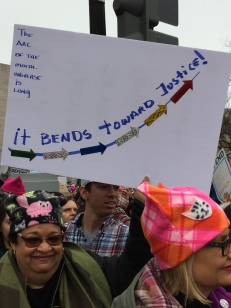
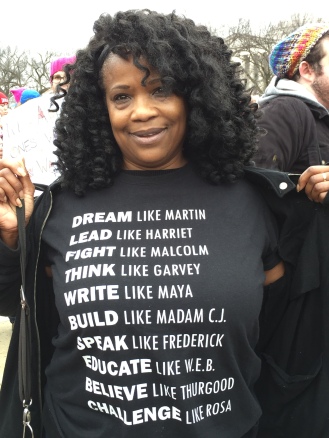
I read their message in their signs – some poignant, some angry, many humorous – but all advocating human rights for all of God’s people.

march-4march-3


What was the point?  The point was to stand together.

march-2

These days it is possible to communicate and cooperate across the globe on-line and through social media. But sometimes we need to get out of our homes – and our comfort zones – and come together.

Sometimes we need to stand shoulder to shoulder, side by side, with one another.

march-5march-6

I came back inspired and energized.

I came back realizing I am not alone in my concern about healthcare, the environment, the LGBT community, immigrants, and people of color.

I came back wanting to help save our planet from thoughtless abuse.

I came back determined to work hard on behalf of those who have no voice or are afraid.

I came back encouraged.

march-7

I won’t give up.

And when I need to, I will march again.

Why I’m marching

I’m a 58-year-old straight white woman with bad feet.  Why am I going to the Women’s March in Washington DC on January 21st?

I’m marching because I want to be part of the conversation. Politicians are always talking. The news cycles are filled with people shouting past each other as they try to force their reality on one another.

There’s a lot of voices out there.

I want to add my voice. My voice will be one of hope, inclusion, and welcome.

I’m marching so I can share what I have learned over 58 years of being a woman, and a pastor, mother, wife, sister, daughter, and an American.

I’m marching my faith.

I want to be involved in what is going on in our country.

I want my voice to be heard. I want to show up, speak up, and share what I believe in.

I want to stand shoulder to shoulder with vast numbers of diverse people across the country and reflect on what it means to love all of my neighbors.

I want to join young and old women of every age, color and ability to declare that every woman deserves to be treated with respect.

I want to march with gay, straight, and trans women and say what is true – each one of us is created in God’s image.

I am not a political activist. I have never done anything like this before.

But I am expending a great deal of time, effort, and resources to ensure that my voice joins thousands of others. Together we will encourage each other to stand up for dignity, equality, and an eager openness to learn about one another.

I am marching a message of love.

I am marching a message of hope.

I am marching a promise never to give up.

I am marching so all people can be included in our nation’s history.

women-march-2

That’s why I’m marching.

I’ll let you know what I experience.

How does God speak to you?

We will be celebrating Star Gift Sunday on January 8th.  This celebration of Epiphany, which marks the day the wise men arrived to worship Jesus, reminds us of the Light shining in the darkness, long after the excitement of Christmas has grown dim. The eight-week season of Epiphany encourages us to wonder

  • Where is God’s Light shining?
  • Where do you encounter God?
  • How –and where – does God speak to you?
  • Are we, like the ancient Magi, actively seeking the Light that is promised to us?

During worship, everyone will receive a paper star imprinted with one of about 200 words. Worshipers are encouraged to reflect on that word, that “star gift,” throughout the coming year.  People use many creative methods to ensure they encounter their star word several times each day. The paper stars get hung on computers, mirrors, refrigerators or are transformed into digital “wallpaper” on phones and computers.  Each glimpse of star gift reminds us that God is in that place, that somehow God is, as the United Church of Christ motto assures us, still speaking to God’s people. We are meant to be listening.

Google informs me that 7012 languages are spoken across the globe. Given that diversity, I am confident that God has a great variety of ways to speak to us.  I am wary of people who insist that there is only one way to discern God’s presence or a single path to the Creator of the universe. Instead, as a child of God filled with God’s Spirit, each of us can listen for the innumerable ways God speaks to us. I have met people who encounter God in

  • A cardinal in the snow
  • A stranger’s kindness
  • A child’s smile
  • The beauty of a sunset
  • The expanse of stars and planets, reminding us of God’s grandeur
  • The certainty of the sunrise, no matter how late or how dim that light may be

I know a young widow who discovers “hearts from heaven” in nature which remind her that love is stronger even than death.

The important thing is to listen, with ears and spirit open to the possibility of God breaking through our everyday lives to speak to our hearts.
In these frightening political times, during tense family encounters, in post-holiday let down, during the bleak mid-winter, at moments or days when you are not sure you can go on – what if we listen? What if we look? What if we notice?

What is God whispering to your spirit today? I won’t presume to tell you. But I do know this:

– The message God has for you is one of love.

– God’s voice is filled with forgiveness.

– God promises faithfulness.  God will never leave or abandon us.

God will love us when no one else does. Even when we don’t love ourselves.

I hope you can join us on Star Gift Sunday. Or send me your address and I will mail you a star.
But even more important –

  • Listen
  • Look
  • Be aware

God is speaking to you today.

star-gift-love


Messages of Light

“Name 10 things you are thankful for.”  It was the morning of December 24th. My husband and I lay in bed, enjoying the calm before the storm known as “the holidays.”  It was, of course, the dawn of Christmas Eve. It also marked the beginning of Hanukkah. Since my husband grew up in a Jewish household, we celebrate both holidays.

“Do the three kids count as one blessing or as three?” he asked, wanting to get the rules of this exercise right, or perhaps just eager for breakfast.  “Each one is an individual blessing,” I decided.  We agreed that each child is unique and deserving of our gratitude and prayers.

We ended our thankfulness list by naming God who, in both our traditions, offers light and encouragement. Whether we are anticipating the arrival of Christmas with our Advent candles or enjoying the increasing light on each night of Hanukkah, we give thanks that God’s faithfulness cannot be dimmed.

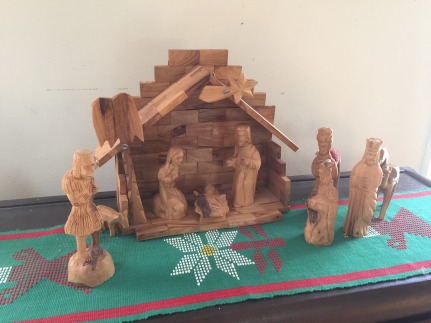
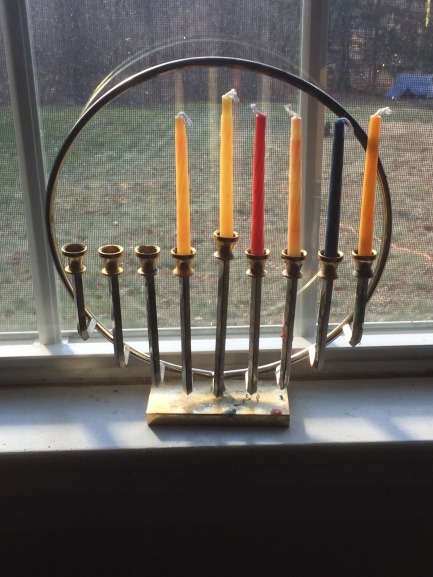
Our menorah and our crèche stand side by side every December.  Each were both made in Israel. I bought the hand-crafted olive wood figures during a three week course in Jerusalem. The menorah was the first purchase my husband and I made as newlyweds.

creche

When our children were little, the shepherds and kings would often wander away from the stable to encircle the lights of the menorah.  That didn’t look wrong to us; it was as if those tiny figures were reminding us that both holidays are about hope and faith, endurance and trust. The gift we endeavored to pass along to our children was the message of faith in an unfailing God and the joy that both holidays can bring.

Before we were married, we worried about how to bring our two faiths together, honoring both, without compromising either. Twenty-five years later, that challenge seems more important than ever.  We live in an era of division, fear and distrust.  It seems critical to take time to review our blessings and listen to the life-giving message our faiths offer.

When I see the lights of the menorah shining on the stable of Bethlehem, it lets me dream about a time when people of all faiths and backgrounds might join together to celebrate hope and resilience. We can listen to and learn from one another as together we share glimpses of our steadfast God.

May that light continue to shine in the New Year and enable us to recognize one another as beloved children of God.

menorah

Daring to care

“Do you have a cigarette?” the young woman muttered as I walked out of our local hospital. I didn’t even glance her way.  She persisted, “Can I get a ride into town?” My guard was up; I had just experienced the hurt and disappointment that comes from trusting a practiced liar. That person managed to take money from me and from members of my church before we realized she was simply conning us for whatever she could get.  That incident left me wary.

So who was this person approaching me at 7:15 a.m. on a frigid weekday? When I finally looked closely at her, I saw a young woman just few years older than my children. I was glad to see she was wearing a winter coat, hat, and gloves, but she looked tired. She smelled faintly of alcohol.

“Are you all right?”  I asked.  She rejected my offer of a cup of coffee or a breakfast sandwich, insisting that a cigarette would start her day off right. I drove her the short distance into town. She got her cigarettes and lit one with shaking hands.

“I’m on my way to go grocery shopping,” I informed her.

“I can wait for you,” she said. She seemed lonely and at loose ends, without any plan for the day ahead.

She perched on a chair in the store’s coffee area while I gathered supplies for Christmas cookies.  As she helped me load my groceries into my car, I asked, “Now what? It’s too cold to stay outside.”

When I asked about family or friends, she explained that her boyfriend “wasn’t that nice” and she didn’t think her family would welcome a phone call from her. I put on my best mother voice as I assured her that even when I’m mad at my children, I still want to know they are safe and cared for. She was unconvinced.

“Do you want to go to the homeless shelter?”  I was certain that suggestion would shake her out of her indecision. Instead, she agreed that was the best course.

During the 20 minute drive to the shelter, she kept me amused with her description of growing up in our area, studying at community college, even attending our church’s Fourth of July Jamboree. My heart ached for her as she casually confessed she was an alcoholic with little hope for the future.

The shelter’s in-take clerk was brisk and to the point:

  • Arrest and sex offender lists are checked before entry.
  • No smoking, no drinking
  • Inside hours are 8 PM to 8 AM. After that, everyone needs to be outside.

I realized just how little I was giving her. She had a warm place to sleep that night but had a long, cold day ahead of her. I gave her my name and phone number and encouraged her to call. I described de-tox programs that could help her and counselors who could offer guidance.  I don’t know if I’ll ever hear from her again.

What I wanted, of course, was a happy ending. I wanted to solve her problems and help her find a safer, healthier path. Instead, I was left a lingering sadness and unsettling glimpse of a difficult life.

Will my small gestures help?  Maybe. Maybe we are all pieces of a much bigger puzzle. Maybe someone else will offer her another helping hand. And then another and another. Maybe each one will add up to make a difference.

Just because we cannot solve a problem is not a reason to hesitate to do what we can.

There are needs all around us. One way we share God’s light is by offering our hands and our hearts. Let us do what we can to help one another on the journey.

How does the church work?

As a small-town pastor, I marvel every day about our church – this unlikely collection of volunteers who allow the love of God to shine through them. Our church looks something like this –  When I arrive early on a Sunday morning, the building is empty, locked and dark.  I begin the weekly process of resuscitation by opening the shutters and unlocking the doors. The real vibrancy arrives as people drift in. There’s the guy who makes coffee each week, here are a couple of people who baked cookies and cut up fruit for fellowship time following worship.  The choir, those impossibly busy people who somehow squeeze in weekly rehearsal time, clamber into the choir loft, eagerly anticipating their anthem.

Dedicated parents and grandparents are organizing paper, scissors, and glue sticks, anxious to share Bible lessons and crafts. The sanctuary hums to life as someone flips on the sound system, another carefully places flowers on our communion table, and some friendly volunteers welcome visitors and regulars alike.  The building is brimming with activity now, as neighbors greet one another and weary young mothers grab precious moments with a kindred spirit. Gray-headed seniors lean in for conversation as teenagers casually compare phones and screens.

Before entering the sanctuary, the deacon questions her ability to draw the attention of this noisy, somewhat unruly crowd to the still, small voice of God.  There is Good News to share – God has promised to show up, right here, in our little corner of CT, because we are gathered in God’s name.

Good morning! The deacon asserts boldly.

Good morning!  The congregation booms in reply.

Peace, one might even say the Spirit, descends upon those gathered, not at all distracted by wriggly babies or bored teenagers. Somehow God meets each one of us, exactly where we are this morning. God is in this place and suddenly – we become the church.  We are the people of God, flawed, imperfect, falling very short of the glory of God, yet blessed and renewed by God’s love which welcomes every single one of us. And because God names us the church, the Body of Christ, we can claim that title as well. Together we can endeavor to serve God by sharing God’s love.

That’s church on a Sunday morning.

How does it work on the other days?

  • Someone drops by to donate skeins of yarn she found on sale. Less than an hour later an older woman stops by to ask for prayer shawl materials. She leaves, eager to knit and pray for some yet unknown recipient who will receive a reminder of God’s encircling love. The church works when we share.
  • Two $50 Visa gift cards arrive in the mail. An out-of-state daughter wants to honor her parent’s anniversary by passing along the love and compassion she inherited from their relationship. Later that same day a young woman was weeping in my office, devastated by the husband who abandoned her and their two-year-old child. $50 wasn’t going to solve her problems, but it heartened her to know someone cared. The church works when we celebrate love.
  • One of our snowbirds returned from Florida, bubbling with excitement. “I discovered Tai Chi,” she exclaimed, “and I want to share it with others.” Her enthusiasm draws in 15-18 people, members and visitors to our church, twice weekly as they share fellowship and gentle exercise. The church works when people follow their enthusiasm.
  • “Art makes people feel good,” a gifted woman in our congregation told me. She has the ability to transform paints, fabrics, or flowers into beautiful creations. “More people should be exposed to art,” she declared. Her invitation inspired 20 artists to gather for a show and sale, transforming our fellowship hall into a combination art gallery and cool craft store.  Visitors receive a transfusion of color and creativity on a cold winter morning. Church works when we share our passion and abilities.
  • Meals shared, prayers offered, cards sent, clothes distributed, hugs given, a listening ear offered.

Seminary professors call this “incarnational theology; the Word made flesh.”

I call it making God visible to the world.  That’s church.


*Oil painting by Karen McFarlin:  kmcf3470@gmail.com